
How to Buy a Floor Sample Sofa: Upholstery, Construction, and What Smart Buyers Look For
Learn how to buy a floor sample sofa with confidence. Understand upholstery, frame construction, pricing, and what smart buyers inspect before purchasing.

FLRPL Editorial Team
Author
The sofa is, for most households, the single most used piece of furniture in the home. It anchors the living room, absorbs years of daily life, and sets the visual tone for the most social space in the house. It is also, by a considerable margin, one of the most expensive furniture purchases most people will make — often ranging from several hundred dollars for an entry-level piece to several thousand for a quality construction with premium upholstery. And yet, despite the cost and the stakes, sofas are purchased impulsively more often than almost any other major item in the home.
The combination of overwhelming selection, aggressive retail pricing tactics, and the difficulty of evaluating construction quality from a photograph often leads buyers to make decisions they regret within a year or two. Many shoppers focus on discount percentages instead of actual value — which is why understanding how local retail pricing really works matters when evaluating furniture deals.The cushions compress unevenly. The fabric pills or fades. The frame develops a creak. The sofa that looked perfect in the store photo looks undersized — or worse, physically won't fit through the front door.
There is, fortunately, a better way to approach this purchase. Shoppers who take time to understand what separates a durable, well-constructed sofa from an attractive but poorly made one consistently make better decisions — and often find exceptional value in places the average buyer overlooks. Floor samples and display models from local retailers represent one of the best-kept sourcing strategies in home furnishings: deeply discounted floor sample sofas and showroom display pieces from known, accountable retailers, available for hands-on inspection before purchase. This guide will walk through everything a thoughtful buyer needs to know, from frame construction and upholstery selection to inspection protocols and pricing mechanics, so that when you find the right sofa, you have the knowledge to recognize it and the confidence to commit.
Why Sofas Are One of the Most Important Furniture Purchases
A sofa that sees regular use in an active household endures an extraordinary amount of stress over its lifetime. Consider the math: if three people sit on a sofa for an average of three hours per day, a well-chosen piece absorbs more than 3,000 hours of use per year. Over a ten-year lifespan — a reasonable expectation for quality construction — that represents more than 30,000 hours of contact weight, friction, compression, and movement. The frame flexes every time someone sits and stands. The suspension system deflects and rebounds thousands of times. The upholstery is stretched, compressed, and abraded continuously. That is a demanding performance standard, and it is the reason that construction quality — not color, not style, not brand recognition — is the most important variable in any sofa purchase.
Pricing across the market reflects this range in quality, though not always transparently. Entry-level sofas in the $400–$900 range typically use lower-grade engineered wood frames, sinuous spring or webbing suspension, and bonded materials that begin degrading within a few years under regular use. Mid-range pieces in the $1,000–$2,500 bracket begin introducing better joinery, eight-way hand-tied or drop-in coil suspension, and higher-performance upholstery. At the upper end of the residential market — $3,000 and above — buyers typically find kiln-dried hardwood frames, premium suspension systems, high-density foam seat cores, and genuine leather or high-end performance fabrics that can be recovered and re-cushioned decades later.
Within this pricing landscape, some of the best available values come from outside the standard retail channel. Floor samples — pieces that have spent time on a retail showroom floor — are often discounted substantially from their original retail price while coming from exactly the same manufacturing source as a brand-new piece. Understanding the distinction between a floor sample, an open-box item, and overstock inventory matters when evaluating these deals, since the discount rationale and condition profile of each category differs in important ways.
Understanding Sofa Construction: What Determines Quality
Before evaluating any sofa — whether new, showroom-used, or clearance — it helps to have a working knowledge of what is happening inside the frame. Construction quality is almost invisible from the exterior of a finished piece, which is why so many buyers rely on brand name or price point as a proxy for quality. Neither is reliable on its own.
The Frame is the structural skeleton of the sofa and the single most consequential component for long-term durability. Quality frames are built from kiln-dried hardwood — typically oak, ash, or beech — which has been dried to reduce moisture content and minimize the warping and cracking that causes frames to loosen over time. Corner blocks, the small diagonal bracing pieces at the joints of the frame, are a reliable indicator of quality construction: well-made frames use glued and screwed corner blocks to reinforce stress points. Lower-quality frames use staples alone or skip corner blocks entirely. Frames built from particleboard, MDF, or low-grade plywood are significantly more prone to failure under sustained stress loads and are common in entry-level and fast-furniture products.
The Suspension System determines how a sofa feels under load and how well it retains that feeling over time. Eight-way hand-tied coil spring suspension is the traditional standard of quality: individual coil springs are hand-tied in eight directions to a hardwood frame base, creating a suspension system that distributes weight evenly and maintains its characteristics for decades with minimal degradation. Drop-in coil units (also called Marshall coils or pocket springs) offer similar performance at a lower labor cost and are common in mid-to-upper-range pieces. Sinuous springs — the S-shaped steel wire springs common in lower-cost construction — offer acceptable initial comfort but tend to lose tension and sag more quickly under regular use. Webbing suspension, which uses interwoven fabric straps, is generally the least durable option and is typically found only in entry-level pieces or accent seating.
Cushion Construction varies enormously and has an outsized impact on both comfort and longevity. High-density foam (typically 1.8 lbs per cubic foot or higher for seat cushions) resists compression and retains its shape significantly longer than low-density alternatives. Many quality sofas wrap foam cores in a layer of Dacron or down wrap to add a softer surface feel while maintaining the structural support of the foam beneath. Loose-fill down or fiber cushions offer a luxurious aesthetic but require more maintenance — frequent refluffing and occasional rotation — to prevent permanent compression. Reversible cushions with zippers, which allow the fill to be replaced or supplemented, are worth prioritizing for any sofa expected to last ten or more years.
Joinery Methods — how the frame components are attached to one another — are among the most telling indicators of construction quality. Dowel-and-glue construction, reinforced with corner blocks, is the most durable standard. Mortise-and-tenon joinery, while less common today, represents the highest traditional quality standard. Metal fasteners and staples alone, without adhesive or corner blocking, indicate cost-reduction choices that typically manifest as frame looseness within three to five years of regular use.
These construction elements are genuinely difficult to evaluate from a photograph, which is one of the distinct advantages of purchasing from a local retailer where physical inspection is possible. A showroom floor — and particularly a floor sample that has seen months of customer interaction — provides more information about construction quality than any product description.
Upholstery Materials: Fabric, Leather, and Performance Textiles
Once construction quality is established, upholstery selection is the most consequential remaining decision. The right upholstery for a given household depends on a combination of durability requirements, aesthetic preferences, maintenance tolerance, and the realities of how the sofa will actually be used.
Natural Fabrics — linen, cotton, wool, and their blends — offer warmth, texture, and a visual quality that is difficult to replicate with synthetic alternatives. They tend to be breathable and comfortable across temperature ranges. The trade-off is maintenance: natural fibers are generally less resistant to staining and fading than engineered alternatives, and many natural weaves have a relatively low rub count, meaning they wear more visibly with heavy use. Linen in particular, while beautiful, can be prone to wrinkling and may not be the right choice for households with children or pets.
Performance Fabrics have advanced significantly over the past decade and now represent the most practical choice for high-use environments. Fabrics engineered under brand names like Crypton, Sunbrella, and Revolution are woven with solution-dyed or coated fibers that resist staining, moisture, and UV degradation without feeling noticeably synthetic. Rub counts for quality performance fabrics often exceed 100,000 double rubs — far beyond what typical residential use demands. Many performance fabrics are now produced with visual and tactile qualities that are nearly indistinguishable from their natural-fiber counterparts.
Leather and Bonded Leather represent opposite ends of the quality spectrum despite similar surface appearances. Full-grain leather — the top layer of the hide, with its natural grain intact — is extremely durable, develops a desirable patina over time, and can last decades with minimal care. Top-grain leather (buffed and finished to remove surface imperfections) is the most common quality leather used in residential furniture: durable, relatively stain-resistant, and available in a wide range of finishes. Bonded leather, also marketed as "reconstituted leather" or "blended leather," is a manufactured material that bonds shredded leather fiber to a polyurethane backing. It has a superficially similar appearance to genuine leather but typically begins peeling, cracking, or delaminating within three to five years of use. It is worth learning to identify the difference: genuine leather will have irregular natural grain patterns and a supple feel that responds to temperature; bonded leather tends to have a perfectly uniform surface pattern and a slightly plastic feel.
Microfiber and Synthetic Blends offer strong practical performance at accessible price points. High-quality microfiber weaves with tight pile are durable, easy to clean, and resistant to snagging. The aesthetic limitations — they can look and feel less refined than natural textiles — are the primary trade-off. For buyers prioritizing durability and easy maintenance over visual richness, a quality synthetic blend is a rational choice.
Local retailers typically carry manufacturer training that enables their staff to explain specific fabric performance characteristics, cleaning codes, and appropriate use cases for each material. This level of product expertise is genuinely useful when evaluating an upholstery purchase, and it is one of the meaningful advantages of working with a specialized local retailer rather than purchasing from a national e-commerce platform. Knowing how to evaluate whether a local home deal is worth it becomes considerably easier when you can ask the right questions of someone with direct product knowledge.
Inspecting a Floor Sample Sofa
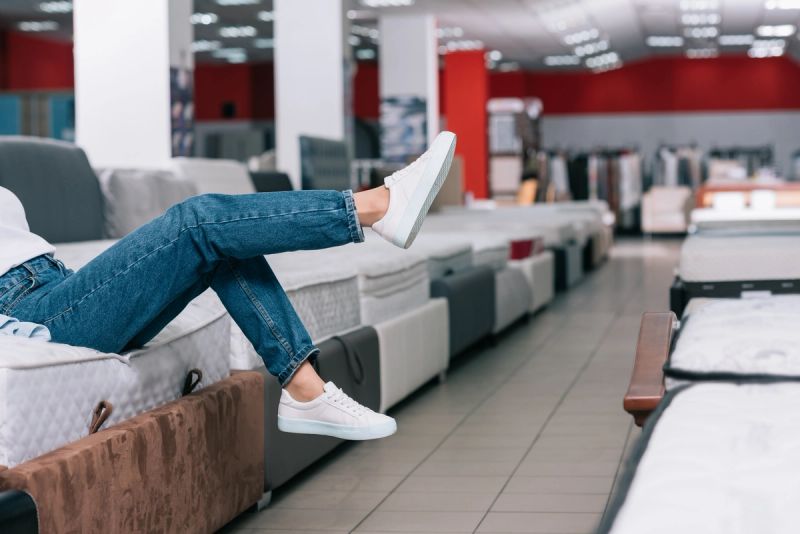
A floor sample sofa offers something that no new piece can: a real-world performance record. By the time a sofa has spent six to eighteen months on a showroom floor, it has been sat on by hundreds of shoppers, evaluated, repositioned, and subjected to daily environmental exposure. That history is visible, and a careful inspection turns it into useful information.
Begin with the frame. Sit down firmly in the center of the seat, then shift your weight to each corner. Stand up and press down on each arm. A well-constructed frame will feel rigid throughout this process — there should be no perceptible flex, creaking, or lateral give. Any structural movement in the frame is a significant warning sign in a sofa that has not yet been in a private home; it indicates either low-quality construction or damage from showroom use.
Examine the seat and back cushions carefully. Some compression in floor sample cushions is entirely normal and expected — this is typically the most visible sign of showroom use and is usually reflected in the discount. What matters is the compression pattern: even, symmetrical compression across the seat suggests normal use, while localized sinking, bunching, or permanent deformation in specific areas indicates either low-density fill or abnormal stress concentration. Remove the seat cushions if possible and examine the suspension system beneath. It should appear intact and consistent across its full width.
Look closely at the upholstery fabric, particularly at the seat front (the horizontal fabric surface at the front edge of the seat), the inside arms, and the top of the back cushions — these are the highest-contact surfaces on any sofa and will show wear first. Some pilling or subtle texture variation is common and cosmetic; actual thinning of the weave, significant fading, or torn seams requires more careful consideration in your pricing calculus.
Check the sofa's contact points with the floor. Legs may show scuff marks from repositioning, and floor-skid bases may have picked up adhesive residue from protective pads. These are cosmetic issues, not structural ones, but they are worth noting. Lift or tilt the sofa slightly if you can — the underside of the frame and dust cover should be intact, with no evidence of repair work or frame damage.
Finally, and particularly for upholstered sofas in neutral fabrics, give the piece a neutral smell assessment. Showrooms vary significantly in air quality and ventilation, and fabric upholstery is an effective absorber of ambient odors. A faint odor of cleaning products or the general retail environment is typically temporary and dissipates after the piece is in a ventilated home environment. Persistent or strong odors warrant investigation. Understanding the retail terminology around these pieces — the distinctions between a floor pull, overstock, clearance, and discontinued inventory — helps set appropriate condition expectations for each category before you inspect.
Measuring Before Buying a Sofa
Of all the preventable mistakes in sofa purchasing, failure to measure is both the most common and the most expensive. A sofa that cannot be moved into your home has no practical value at any price. The delivery and removal costs for a piece that doesn't fit — particularly a large sectional or deep-seat sofa — can easily exceed several hundred dollars.
The measurement process requires more precision than most buyers expect. The sofa itself has a height, width, and depth, but those dimensions tell only part of the story. The critical constraints are typically the delivery path: the width of the exterior entry door, the height and width of any interior doorways the piece must pass through, the turning radius at the base of a staircase, and the clearance in any elevator. Large sofas must often be tilted, turned, or disassembled to navigate standard residential entry points.
FLRPL's complete guide to measuring furniture and appliances before buying walks through the full measurement process with specific guidance for large upholstered pieces. The key practical advice: measure every doorway and turning point, not just the front door, and measure the diagonal of each opening in addition to the standard height and width, since large rectangular pieces are almost always moved on a diagonal to navigate tight clearances.
Pricing: Why Floor Sample Sofas Can Be Exceptional Deals
Understanding how furniture is priced at retail helps buyers evaluate floor sample and clearance discounts with appropriate skepticism — and recognize genuine value when it appears.
Most furniture retails at a significant markup over wholesale cost, with MSRP (manufacturer's suggested retail price) functioning more as an anchor than as a true market price. Promotional pricing in furniture retail — "50% off" events, weekend sales, inventory clearance events — is so pervasive that many buyers have learned to discount these signals entirely. The actual transaction price at a reputable local retailer often falls within a relatively narrow range regardless of the promotional framing.
Floor samples and display models represent a fundamentally different pricing category. These pieces are being sold at a genuine discount for a specific, legitimate reason: the retailer needs to rotate the item off the floor, often to make space for a new model or updated fabric color, and the item's showroom history means it cannot be represented as new. Discounts on floor samples — especially floor sample sofas from reputable retailers — typically range from 20% to 50% off original retail price for furniture in good showroom condition, with deeper discounts applied to pieces with visible wear, discontinued upholstery, or older frame designs. For a $2,800 quality sofa, a 35% floor sample discount represents $980 in recovered value on a piece with identical underlying construction.
FLRPL's guide to local retail pricing explains the mechanics of how these discount tiers work across different inventory categories — a useful reference when comparing prices across retailers.
Local Pickup vs. Shipping for Large Furniture
The practical logistics of acquiring a large sofa deserve serious attention before purchase. Freight shipping for oversized furniture — which typically involves a curbside delivery from a freight carrier, not a white-glove service — introduces several risks that are often underappreciated until they materialize.
Freight damage during transit is a well-documented problem in the furniture industry. Large upholstered pieces shipped on pallets through standard freight networks are exposed to significant vibration, compression from stacked items, and handling at multiple transfer points. Damage can range from minor cosmetic issues (small tears in fabric, broken legs) to significant structural damage that is not always visible during initial inspection. The claims process for freight-damaged furniture is time-consuming and often disputed.
Beyond damage risk, freight delivery scheduling for large items typically offers limited arrival windows and does not include in-home placement, stair carries, or debris removal. White-glove delivery services that do provide these services add meaningfully to the landed cost of the piece.
Local pickup, or local delivery from a nearby retailer, resolves most of these concerns. The piece is inspected before it leaves the store, transported on a short, direct route, and typically delivered by personnel who are accountable to the retailer you purchased from. For a floor sample or clearance piece that you have already inspected in person, local logistics complete the chain of visibility from manufacture to placement in your home. FLRPL's overview of local pickup versus shipping for large items covers these trade-offs in detail.
Why Buying From Local Retailers Matters
The shift toward online furniture purchasing has genuine advantages — convenience, selection breadth, and the ability to compare prices across dozens of sources simultaneously. But for a category as tactile and construction-dependent as upholstered seating, something is genuinely lost when the purchase moves entirely online.
Local furniture and home furnishings retailers — particularly the independent and regional dealers who specialize in specific categories — tend to carry product lines with more depth than mass-market retailers and to employ staff with meaningful product knowledge. The person on the floor at a quality local furniture showroom can often tell you the suspension type, the foam density, the frame material, the upholstery cleaning code, and the lead time for replacement cushions on a given piece. That depth of knowledge is not available from a product page.
There is also an accountability dimension to local retail that matters specifically for higher-value purchases. A local retailer who sells you a sofa will see you again — possibly many times, since home furnishings buyers return repeatedly over the course of furnishing and refreshing a home. That ongoing relationship creates a different kind of incentive than a national e-commerce transaction. Service after the sale, assistance with warranty claims, and the ability to physically return to the store with a concern are all meaningfully more accessible when the retailer is a local business. A direct comparison of buying from local retailers versus online and big-box alternatives outlines these differences across the full purchase experience.
How Smart Shoppers Find the Best Deals
Until recently, discovering floor sample and clearance inventory from local retailers required either physical legwork — visiting multiple showrooms to ask what was being rotated off the floor — or relying on relationships with store staff who might call with notifications. Neither approach scaled particularly well for most shoppers.
The emerging alternative is platforms that aggregate this inventory in one place, making it possible to browse local floor samples, overstock, and clearance items from multiple retailers simultaneously before deciding which stores to visit. This changes the dynamic meaningfully: a shopper can now survey a significant portion of available local inventory digitally, identify the most promising pieces, and visit the store specifically to inspect and purchase, rather than spending hours walking through showrooms hoping to find something relevant. Understanding how to find the best inventory drops on FLRPL covers the practical mechanics of using this kind of local discovery tool effectively.
How FLRPL Helps Shoppers Discover Local Sofa Deals
FLRPL is a local retail marketplace built specifically for this kind of shopping. The platform connects buyers with verified local retailers who are actively listing floor samples, open-box items, clearance pieces, overstock inventory, and showroom display furniture across categories including furniture, appliances, lighting, and home décor.
The design premise is that the best local inventory — the floor sample sofa from a quality regional furniture dealer, the discontinued sectional in an excellent fabric that simply didn't fit the retailer's current floor plan — often never reaches most shoppers. It's sold quietly to someone who happened to walk in, or it sits until the retailer moves it to a back room and eventually liquidates it. FLRPL brings this inventory into view before that happens, enabling shoppers to find it, evaluate it digitally, and then visit the store to inspect it in person before purchasing.
Every listing on FLRPL comes from a verified local retailer — not from individual resellers or anonymous private sellers. That distinction matters for the category: a floor sample sofa listed by a local furniture dealer comes with the retailer's accountability, their ability to answer construction and upholstery questions, and typically some form of post-sale support. How FLRPL works, why the platform is designed around local retailers, and how to browse available inventory drops are all worth reviewing before beginning a search.
Conclusion
A sofa is not a commodity purchase. It is an investment in daily comfort, in the visual coherence of the most used room in your home, and in a piece of furniture that — if chosen and cared for well — can serve a household for fifteen or twenty years. The buyers who make the best sofa decisions are consistently the ones who take time to understand what they are actually evaluating: the quality of the frame, the durability of the suspension, the realistic longevity of the upholstery, and the mechanics of how floor sample pricing works relative to the retail channel.
Armed with that knowledge, the floor sample and clearance market at local retailers looks considerably more attractive than it might otherwise. A deeply discounted floor sample from a reputable local dealer is not a consolation prize — it is often the most intelligent available path to a quality piece at a price that reflects reality rather than retail theater. The sofa has already proven itself on a showroom floor. The retailer is accountable and accessible. The piece can be inspected in full before any money changes hands.
Preparation matters just as much as knowledge. Measuring your delivery path before you fall in love with a piece prevents the most avoidable and expensive mistakes. Understanding the difference between a floor pull and an overstock item helps you set appropriate expectations for condition. Knowing how to evaluate an upholstery fabric against your household's actual use requirements prevents the regret of choosing beauty over durability.
The combination of an informed buyer and a trusted local retailer consistently produces better outcomes than the impulsive, photography-driven purchases that define much of the furniture market today. Take the time to understand what you are looking at — and when you find the right piece, you will know it.
Related Articles

Floor Sample vs. Open-Box vs. Overstock: What’s the Difference?
Learn the difference between floor samples, open-box items, and overstock. Compare condition, warranties, pricing, and risks to shop smarter on FLRPL.


What Is a Floor Sample? The Smart Shopper's Guide to Showroom Deals
Floor samples are discounted showroom pieces. Learn why they’re sold, typical savings, what to check, and how FLRPL helps you find verified local Drops.
How to Find the Best Drops on FLRPL: A Shopper's Guide
Learn how to find the best floor samples, open-box items, and overstock deals on FLRPL. Tips for browsing local drops, inspecting condition, and shopping smarter.
Don't Miss the Next Drop
Be first to know when premium floor samples, open-box items, and clearance goods hit the market near you.