
Local Retail Repriced: The Hidden Math Behind Storefront Pricing
Understand the hidden math behind local retail pricing—MSRP, margins, inventory carry costs, and why repriced showroom inventory creates real value.

FLRPL Editorial Team
Author
FLRPL Journal | Retail Intelligence Series
The $4,000 Question
A mid-century sectional sits in a showroom under track lighting. Charcoal linen, clean lines, the kind you've saved to a Pinterest board. The floor tag reads: ~~$4,000~~ $1,799.
Four questions form instantly:
What does that original price actually mean?
Who decided this markdown—and why now?
Is there something wrong with it?
Is this a real discount, or was it never truly $4,000?
Most shoppers respond in one of two ways: impulse-buy from FOMO, or walk away skeptical. Both reactions stem from the same root problem: we don't know how retail pricing actually works.
The answer isn't sale theater. It's inventory mathematics, vendor relationships, and the cost of floor space measured in dollars per day. It's what happens when retailers apply actual economics to physical goods—a system we call Local Retail Repriced.
This isn't a marketing phrase. It's a structural description of how modern storefront pricing functions when separated from artificial scarcity and promotional noise. Understanding the mechanics changes everything about how you evaluate value in furniture and home goods.
Here's how it really works.
How Retail Pricing Actually Works
The common assumption: retailers buy wholesale, add markup, sell retail. Cost + profit = price. Simple.
The reality is a multi-variable system involving manufacturer agreements, vendor incentives, carrying costs, floor space economics, and inventory velocity targets. Let's break it down.
The Foundation: MSRP vs MAP
MSRP (Manufacturer's Suggested Retail Price) is exactly what it sounds like—a price the manufacturer suggests. It's not binding. It's a reference point for positioning and margin structure.
MAP (Minimum Advertised Price) is different. It's contractual. Brands tell retailers: "You can sell below this price, but you cannot advertise below it." Violation risks losing vendor authorization.
Example:
- Tempur-Pedic mattress: MSRP $3,499
- MAP set at $3,299
- Retailer floor price: $3,099 (permissible)
- Advertised price in local newspaper: cannot show below $3,299 without brand penalty
This creates strategic pricing layers. Retailers navigate constant tension between competitive positioning and vendor compliance.
The Real Margin Structure
Consumer perception: furniture carries 50-100% markup. Reality is more nuanced.
Typical wholesale-to-retail margins by category:
- Entry-level furniture: 40-50% margin (a $500 chair costs the store ~$300)
- Mid-tier furniture: 50-60% margin (a $2,000 sofa costs ~$900-1,000)
- High-end/designer: 45-55% margin (margins compress at higher price points)
- Appliances: 20-35% margin (highly competitive, volume-driven)
That margin is not profit. From that spread, retailers pay:
- Rent (typically $30-80 per square foot annually in suburban centers)
- Labor (sales floor, warehouse, delivery crews)
- Freight (inbound shipping from vendors)
- Marketing (local advertising, digital spend, showroom design)
- Carrying costs (interest on inventory financing)
Net operating margin for independent furniture retailers typically runs 3-8% after all expenses. Big-box chains achieve 5-10% through volume advantages and operational leverage.
The Hidden Layer: Vendor Rebates and Co-Op Dollars
This is where retail economics diverge from surface-level markup math.
Many furniture retailers operate on back-end rebate structures:
- Volume rebates: Hit $500K annual purchases from a vendor, receive 3% rebate
- Floor model allowances: Vendor provides $200-500 per display unit to offset depreciation
- Co-op advertising: Vendor funds 50% of local ads featuring their products
- Seasonal closeout credits: Vendor offers 10-20% off discontinued SKUs to accelerate clearance
Strategic implication: A retailer might sell that $1,799 sectional at break-even or slight loss on the transaction itself—but recoup margin through back-end vendor rebates triggered by volume thresholds. This creates incentive structures that favor aggressive repricing to move units.
Seasonal Resets and Product Lifecycles
Furniture and home goods operate on predictable refresh cycles:
Standard vendor introduction schedule:
- January-February: Spring collections launch
- July-August: Fall collections arrive
- October-November: Holiday inventory shifts
When new models arrive, existing floor inventory must clear. A sofa displayed for nine months isn't defective—it's occupying showroom real estate needed for current-season product.
Floor model depreciation follows a predictable curve:
- Months 1-3: Minimal depreciation, minor display wear
- Months 4-9: Moderate depreciation, 15-30% off MSRP becomes standard
- Months 10+: Aggressive repricing, 40-60% off MSRP to accelerate turnover
This isn't desperation pricing. It's inventory velocity management—the deliberate acceleration of capital cycling through physical goods.
The Economics of Open-Box Returns
Open-box items follow different math entirely.
Scenario: Customer purchases a $2,500 dining set, takes delivery, changes their mind within the 30-day return window.
Retailer's options:
- Resell as "open-box" at 20-40% discount: Faster sale, preserve cash flow
- Return to vendor: Incur restocking fees (typically 15-25%) plus return freight
- Hold as floor model: Risk extended holding period while paying rent and interest
The math usually favors option 1. Selling at $1,499 open-box beats absorbing a $625 restocking fee (25% of $2,500) plus $200 in return freight costs. Total loss in option 2: $825. Option 1 generates $1,499 in recovered capital.
This is why open-box inventory appears at steep discounts—not because the item is damaged, but because the alternative is worse.
Cash Flow Pressure: The Flooring Line System
Most furniture retailers operate on flooring lines—specialized inventory financing from third-party lenders.
How it works:
- Retailer orders $50,000 in sofas from vendor
- Finance company pays vendor directly
- Retailer pays interest (typically 6-12% annually) until item sells
- Upon sale, retailer pays off principal
This creates time pressure. Every month a $3,000 sofa remains unsold, the retailer accrues $15-30 in interest charges. Over 12 months: $180-360 in carrying costs—in addition to the rent for floor space it occupies.
Repricing decision matrix:
- Option A: Sell at 30% discount, recoup 70% of retail value immediately, stop carrying cost bleed
- Option B: Wait for full-price buyer while paying monthly interest and rent
For inventory aged beyond 6-9 months, option A is mathematically superior in most scenarios. This is capital allocation, not failure.
Discounting vs Liquidation vs Repricing: Precise Definitions
The language of price reduction is imprecise in common use. Definitions matter for understanding what's actually happening.
Discounting
Temporary price reduction to drive traffic or move specific inventory. Time-bound (Labor Day sale, Black Friday event). Margins are maintained or slightly compressed. Goal is volume, not desperation.
Example: 20% off all dining sets this weekend.
Clearance
Permanent price reduction on items being phased out. Vendor discontinued the line, store needs floor space for new models. Pricing reflects urgency but not distress.
Example: 40% off 2024 patio furniture as 2025 collections arrive.
Liquidation
Sell everything regardless of margin to generate immediate cash. Typically signals store closure, bankruptcy, or severe financial distress. Prices drop to wholesale cost or below.
Example: Going-out-of-business sales where fixtures themselves are for sale.
Markdown
Incremental price reduction over time. Common in apparel—start at 20% off, increase to 40%, then 60% as weeks pass. Less common in furniture due to fewer identical units and slower inventory turns.
Example: Specific rug drops from $899 to $699 to $499 over 90 days.
Repricing
Strategic price adjustment based on inventory economics, not promotional calendars. Reflects actual carrying costs, floor age, vendor incentives, and opportunity cost of occupied space.
This is the critical distinction: Repricing is analytical, not reactive. It's the application of real-world cost accounting to physical inventory.
Common repricing triggers:
- Vendor line changeover (2024 models out, 2025 models arriving)
- New model introduction (previous generation must clear)
- Floor sample rotation (item displayed 6+ months)
- Open-box return (cannot return to vendor economically)
- SKU discontinuation (manufacturer ceased production)
Repricing reflects capital efficiency priorities—not distress signals.
The Economics of Square Footage: Why Floor Space Has a Price
Every square foot of showroom carries quantifiable cost. This invisible pressure drives repricing decisions.
Rent Cost Per Square Foot
Furniture and home goods retailers operate in:
- Suburban strip centers: $20-40/sq ft annually
- Urban storefronts: $50-100/sq ft annually
- Premium shopping districts: $100-200+/sq ft annually
Cost calculation example:
- 10,000 sq ft showroom at $30/sq ft = $300,000 annual rent
- Monthly cost: $25,000
- Daily cost: $833
- If a sectional occupies 80 sq ft, it costs $6.67/day in floor space alone
The Compounding Cost of Stagnant Inventory
Stagnant inventory generates compounding carrying costs over time.
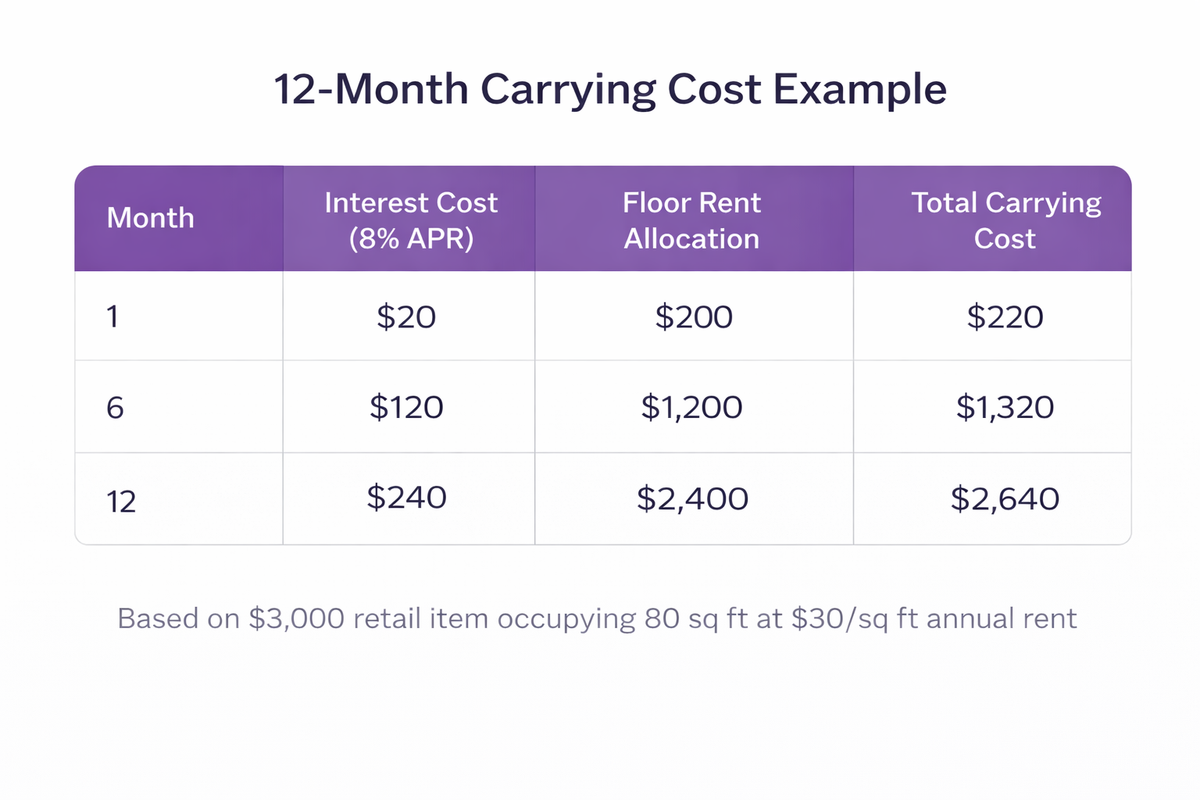
After 12 months, this $3,000 sofa has generated $2,640 in carrying costs. Marking it down to $1,800 and selling immediately generates cash flow and eliminates ongoing bleed—even though nominal margin appears compressed.
Cash Flow vs Margin Compression: The Strategic Trade-Off
Retailers face constant tension between two objectives:
- Maximize gross margin: Hold for full price (if demand materializes)
- Maximize inventory velocity: Reprice for faster cash conversion
Inventory turnover ratio measures this:
Turn Ratio = Annual Sales ÷ Average Inventory Value
- High-performing furniture retailers: 4-6 turns per year
- Slower-moving showrooms: 2-3 turns per year
Example comparison:
- Item A: Sells in 2 months at $3,000 full price = $18,000 annual contribution (6 turns)
- Item B: Sells in 2 weeks at $2,000 repriced = $52,000 annual contribution (26 turns)
Item B generates nearly 3x the annual value despite lower unit margin. This is why repricing is strategic capital management, not margin failure.
Why "Local Retail Repriced" Differs From Anonymous Resale
Not all discounted home goods carry equal risk profiles. The structural differences create meaningful buyer protection asymmetries.
Structural Comparison
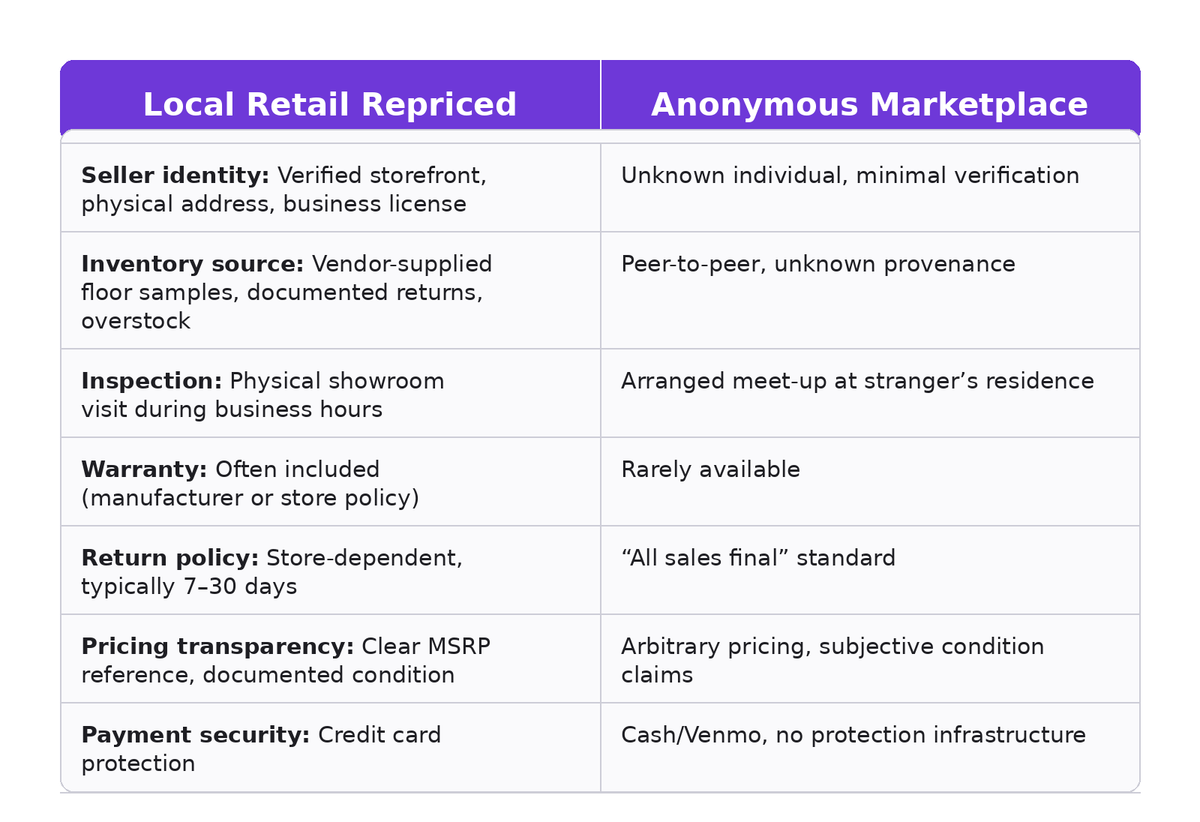
Core difference: Local retail repricing operates within commercial accountability frameworks. The store has a fixed location. You can return tomorrow if issues emerge. The business has reputational exposure and regulatory obligations.
Anonymous resale has none of this infrastructure. It's efficient for certain use cases—but fundamentally unstructured for high-value transactions.
Risk Profile Scaling
For a $50 lamp: Facebook Marketplace risk is negligible. Worst case: $50 loss.
For a $2,000 sectional: Risk profile transforms entirely.
- Can you inspect fabric quality under proper lighting?
- Can you verify dimensions fit your space before committing?
- What recourse exists if structural damage isn't visible in photos?
- Who coordinates delivery logistics for 200+ pound furniture?
Local retail repricing solves these problems by maintaining commercial infrastructure—physical showroom, return policies, delivery coordination, staff expertise—while offering inventory-responsive pricing.
The Trust Layer: Why Storefront Identity Reduces Buyer Risk
Trust in commerce isn't abstract sentiment. It's a function of enforceable accountability mechanisms.
Why Physical Storefronts Create Structural Trust
Purchasing from a local retailer—even at repriced terms—means buying from an entity with:
- Fixed physical location: Store doesn't disappear after transaction
- Business licensing: Registered entity with tax ID, regulatory compliance
- Reputation exposure: Online reviews, Better Business Bureau ratings, community visibility
- Vendor relationships: Authorized dealer status, manufacturer support access
- Staff expertise: Employees trained on product specifications, compatibility, care
This creates multi-layer accountability:
- Store's local reputation at stake
- Manufacturer's brand represented through authorized dealer
- Payment processing enables dispute resolution
- Local pickup permits pre-purchase physical inspection
Why Proximity Collapses Information Asymmetry
Distance creates information gaps. Online furniture purchases from distant warehouses introduce:
- Photo distortion (color accuracy, scale perception, texture)
- Shipping damage risk (common for large items)
- Return complexity (freight coordination, expensive, slow)
- Assembly quality unknown until delivery
Local proximity eliminates these gaps:
- Inspect exact item in person
- Touch fabric, test cushion firmness, assess build quality
- Measure dimensions on-site
- Arrange pickup within days (sometimes same-day)
- Return to physical location if issues arise
This is why local repricing beats online clearance for high-ticket goods. You're trading marginal price savings for dramatically reduced transaction risk.
Knowledge Base Resources
For tactical guidance on evaluating repriced inventory:
- "What Is a Floor Sample? (And Should You Buy One?)" — Floor model economics and condition assessment frameworks
- "Floor Sample vs Open-Box vs Overstock: What's the Difference?" — Inventory category definitions
- "How to Tell If a Local Home Deal Is Worth It" — Evaluation checklist and pricing validation
- "Will It Fit? The Pre-Purchase Measurement Guide" — Spatial planning to avoid costly errors
- "Local Pickup vs Shipping: The Real Math" — When proximity beats convenience
- "Why Buying From Local Retailers Beats Big-Box" — Long-term value analysis beyond transaction price
Understanding repricing mechanics is foundational. Executing informed purchases is application.
How to Evaluate a Repriced Item: Practical Due Diligence
Repricing creates opportunity for informed buyers. Smart evaluation separates value from false economy.
Pre-Purchase Checklist
Condition & History:
- Is this a floor model? How many months displayed?
- Is this an open-box customer return? What was return reason documented?
- Is this overstock (new, never displayed)?
- Are cosmetic imperfections documented? Request photos/video if not visible in person.
Pricing & Value Validation:
- What is manufacturer's current MSRP? (Verify on brand website)
- What is this store's non-sale price for new equivalent?
- What is the repriced offer—and what triggered repricing?
- Are comparable items available at other local retailers for comparison?
Warranty & Post-Purchase Support:
- Is manufacturer warranty still active? (Often yes for floor models <12 months old)
- Does store offer supplemental warranty or satisfaction guarantee?
- What is return policy on repriced items? (Often 7-14 days vs 30 for new)
Fit & Logistics:
- What are exact dimensions? (Bring tape measure to showroom)
- Will it fit through doorways/stairwells? (Measure your space in advance)
- Is delivery included, or pickup-only?
- If pickup, do I have appropriate vehicle/trailer?
Future Considerations:
- What is the replacement model? (Discontinued items may lack future parts availability)
- Can I order matching/complementary pieces later?
- Is vendor still producing this product line?
Execute tactically. Repricing is opportunity—informed buyers extract maximum value.
The Broader Shift in Retail: Structural Forces Driving Change
Understanding repricing requires understanding the larger forces reshaping furniture and home goods commerce.
Chronic Overproduction
Manufacturing operates on forecast-driven production:
- Vendors manufacture inventory 6-12 months ahead of retail delivery
- Retailers place orders based on projected demand
- Economic conditions shift, trends evolve, forecasts miss
- Inventory mismatches become structural, not exceptional
Result: Persistent overstock across vendor and retail tiers. Repricing functions as the system pressure relief valve preventing capital lock-up collapse.
Accelerating Product Lifecycles
Product refresh cycles have compressed:
- Historical standard: Furniture lines refreshed every 3-5 years
- Current reality: 1-2 year cycles (driven by social media trend acceleration)
Implication: A sofa from 2023 isn't defective in 2025—but it's "aged" by trend standards. Retailers must reprice legacy inventory to make floor space available for trend-current product.
E-Commerce Price Transparency
Online retail created instant price comparison across unlimited competitors:
- Consumers check 10+ sites before purchasing
- Algorithmic pricing creates perceived "fair value" anchors
- Patience for full-price purchasing has eroded structurally
Retailers respond with proactive repricing rather than waiting for customer negotiation. The market shifted from "customer asks for discount" to "retailer offers discount preemptively."
Online vs Showroom Cost Structure Distortion
E-commerce furniture operates fundamentally different economics:
- No physical showroom expenses
- Drop-ship models (minimal inventory holding)
- Lower labor costs (no sales floor staffing)
- Marketing-intensive customer acquisition
This creates misleading price comparison. A $1,200 online sofa isn't inherently "better value" than a $1,800 showroom equivalent—it reflects different cost structure. The showroom version may offer superior build quality, immediate pickup, physical inspection—but appears "overpriced" due to false equivalency.
Repricing helps local retailers narrow perceived price gaps while maintaining service infrastructure online models cannot replicate.
The Counter-Trend: Local Retail as Curated Discovery
A meaningful counter-force is emerging: showrooms as antidote to decision fatigue.
Consumer exhaustion with:
- Infinite online SKU scroll (analysis paralysis)
- Photo-reality mismatch uncertainty
- Delivery delays and damage frequency
- Impersonal transactional experiences
Showrooms offer:
- Curated selection (fewer choices, higher decision confidence)
- Immediate availability (purchase today, pickup today)
- Human expertise (staff answering compatibility questions)
- Tangible evaluation (touch, sit, measure before committing)
Repricing makes this model accessible beyond luxury demographics. It's not "premium showrooms for wealthy buyers"—it's inventory-efficient retail for informed consumers.
Where FLRPL Fits: Infrastructure, Not Intermediation
FLRPL is not a marketplace. It's a structured visibility layer for local retail inventory economics.
Core Function
For shoppers:
- Aggregates repriced inventory from verified local retailers in searchable format
- Provides transparent condition categorization (floor sample, open-box, overstock, clearance)
- Displays original MSRP alongside current repriced offer for value assessment
- Enables geographic filtering for proximity-based discovery
- Surfaces inventory otherwise discoverable only through sequential store visits
For retailers:
- Creates qualified demand visibility for aged inventory
- Reduces carrying costs through accelerated inventory velocity
- Attracts informed buyers who understand repricing economics
- Maintains brand positioning (premium goods, strategic pricing)
What FLRPL Does Not Do
- Set prices (retailers maintain complete pricing control)
- Hold inventory (all items remain in retailer showrooms)
- Facilitate peer-to-peer transactions (only verified commercial retailers participate)
- Provide financing or warranties (those remain retailer-specific policies)
FLRPL is infrastructure for price discovery—not a transaction layer. Think: Bloomberg Terminal for local furniture repricing. Pricing intelligence, inventory transparency, trust verification.
The Value Creation
For decades, repriced inventory was discoverable only through:
- Random showroom visits (inefficient, time-intensive)
- Email newsletter subscriptions (cluttered, inconsistent)
- Social media advertising (algorithm-dependent, interruptive)
- Word-of-mouth (limited reach, unsystematic)
FLRPL creates structured discoverability for inventory that's always existed but never been systematically visible at scale.
Final Word: Alignment Over Cheapness
When a retailer reprices a floor sample sofa from $3,200 to $1,899, they're not admitting failure. They're optimizing capital allocation.
That sofa cost $1,600 wholesale. It generated $300 in carrying costs over nine months. It now occupies floor space worth $200/month that's needed for incoming spring inventory. At $1,899, the retailer recovers cost, stops ongoing expense bleed, and frees premium showroom real estate.
The informed shopper receives:
- $3,200-quality item at 40% discount
- Immediate pickup availability
- Warranty coverage (if item age <12 months)
- Physical pre-purchase inspection
- Accountability from established local business
The retailer achieves:
- Cash flow for reinvestment in current inventory
- Eliminated carrying costs
- Sale to educated buyer (not bargain-hunter demanding further concessions)
This is alignment. Both parties benefit from pricing transparency and economic clarity. No information asymmetry, no artificial scarcity theater, no manufactured urgency.
The future of local retail isn't static showrooms waiting for full-price buyers. It's dynamic, inventory-responsive pricing paired with structurally informed consumer behavior.
"Local Retail Repriced" describes this system—where retail pricing reflects actual economics rather than promotional noise, and where informed buyers and efficient retailers find mutual advantage.
It's not about buying cheap. It's about understanding what price actually means.
FLRPL Journal | Retail Intelligence for Informed Buyers
Related Articles

Your Storefront Starts Before the Front Door
Shoppers often research before visiting a store. See how product-level visibility can help local inventory become discoverable before they reach the front door.


The Inventory Is Already There. The Audience Isn't.
Local retailers already have inventory on the floor. See how product-level discovery can give that merchandise another way to be discovered by nearby shoppers.

The Showroom Can Be Discovered Before the Visit
A physical showroom holds more than its storefront can communicate. See how product-level discovery can make local inventory visible before a shopper visits.
Discover What's Waiting Nearby
Browse inventory from verified local retailers near you.

