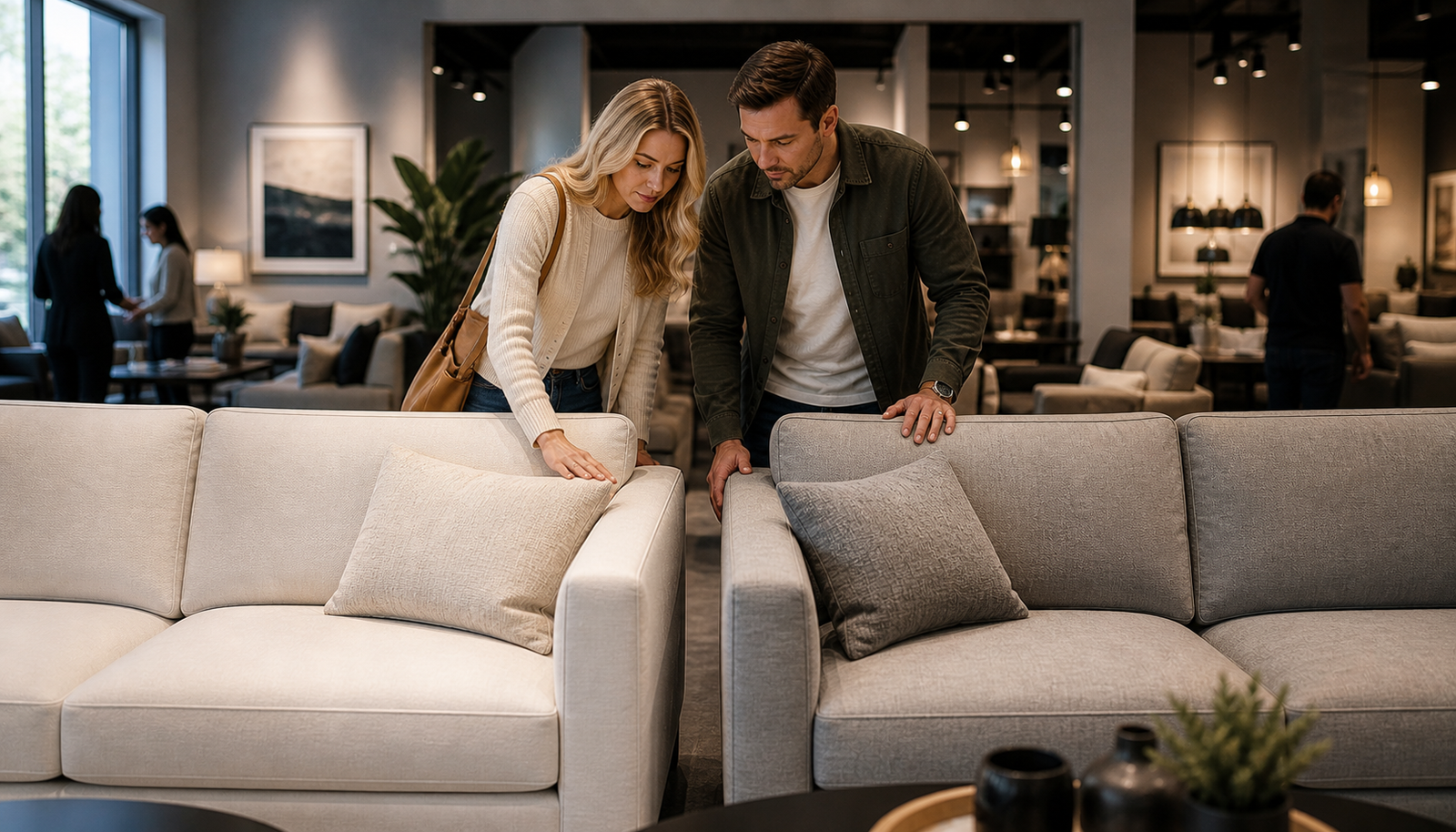
Shopper evaluating the comfort and condition of a modern sofa in a furniture showroom
Buying Guide19 min read

Floor Sample vs. Open-Box vs. Overstock: What’s the Difference?

Learn the difference between floor samples, open-box items, and overstock. Compare condition, warranties, pricing, and risks to shop smarter on FLRPL.

FLRPL Editorial Team

FLRPL Editorial Team

Author

December 27, 2025

You're browsing local furniture deals and find three sectional sofas from the same manufacturer, all priced below retail. One is labeled "floor sample" at $1,400. Another is marked "open-box" at $1,650. A third says "overstock clearance" at $1,750. All three claim to be discounted from the same $2,800 retail price.

Which one is the best deal?

The answer depends entirely on what these labels actually mean—and most shoppers don't fully understand the differences.

Floor samples, open-box items, and overstock inventory represent fundamentally different products with distinct condition profiles, warranty implications, risk levels, and value propositions. A floor sample might have visible wear from months of showroom use. An open-box item could be pristine or moderately used depending on why it was returned. Overstock inventory should be brand new and untouched.

These distinctions directly impact pricing fairness, warranty coverage, return eligibility, and long-term satisfaction. Treating all discounted inventory as interchangeable leads to poor purchase decisions—paying too much for compromised condition, or passing on excellent value because you don't understand what you're evaluating.

This guide provides a comprehensive framework for understanding floor samples, open-box returns, and overstock inventory—what differentiates them, how they're priced, what risks they carry, and which category makes sense for your specific shopping situation.

TL;DR: Quick Reference Guide

Floor Samples:

  • What: Display models used in showrooms, typically 3-12 months
  • Condition: Good to excellent with visible cosmetic wear
  • Discount: 30-60% off retail
  • Warranty: Limited or partial remaining coverage
  • Risk: Low to moderate (cosmetic issues, reduced warranty)
  • Best for: Maximum savings, immediate need, tolerance for minor wear

Open-Box Items:

  • What: Customer returns, packaging-damaged items, brief display use
  • Condition: Highly variable—near-new to moderately used
  • Discount: 20-40% off retail
  • Warranty: Variable—sometimes full, sometimes none
  • Risk: Moderate (condition uncertainty, warranty gaps)
  • Best for: Near-new condition at discount, willingness to inspect carefully

Overstock Inventory:

  • What: Excess new inventory retailers need to clear
  • Condition: New and unused
  • Discount: 20-35% off retail
  • Warranty: Full manufacturer warranty
  • Risk: Minimal (discontinued model support only concern)
  • Best for: Low-risk purchases, warranty priority, need for matching multiples

Decision Framework:

  • Prioritize savings + accept wear = Floor samples
  • Want near-new + willing to inspect = Open-box
  • Prioritize warranty + low risk = Overstock

Critical insight: The category alone doesn't determine value. A floor sample in excellent condition with remaining warranty may be better value than an open-box item in fair condition with no warranty—even at similar pricing.

Understanding Inventory Categories: Why the Distinctions Matter

Retailers use these three categories to describe different types of discounted inventory, but the terminology is often applied inconsistently or interchangeably in listings. Understanding what each category actually represents helps you evaluate whether pricing is fair and condition expectations are reasonable.

Why Retailers Discount Inventory Differently

Each category serves a different business purpose:

Floor samples solve space constraints: Showroom square footage is expensive. When new furniture collections arrive or seasonal displays refresh, older floor models must be cleared to make room. Retailers price these to move quickly.

Open-box items recover value from returns: When customers return purchased items, retailers cannot resell them as new. They must discount to offset the "used" perception, even if the item is pristine.

Overstock clears excess inventory: Ordering too much inventory ties up capital and warehouse space. Retailers discount to convert inventory back to cash and free up storage for more profitable items.

Pricing reflects different value propositions: Floor samples receive the deepest discounts because they have visible wear. Overstock receives moderate discounts because items are new. Open-box falls in between because condition varies.

The Problem with Inconsistent Labeling

Common labeling issues in marketplace listings:

  • "Floor model" used to describe any discounted item, not actual showroom displays
  • "Open-box" applied to floor samples that were never sold to customers
  • "Overstock" used for old inventory regardless of condition
  • Categories mixed within single listings without clear differentiation

Why this creates evaluation challenges:

You cannot assess whether a price is fair without knowing what you're actually buying. A $1,400 sectional is excellent value as a floor sample in good condition, fair value as an open-box return in very good condition, and poor value as overstock (which should be new).

The verification requirement: Always confirm the actual item history—how long it was displayed, whether it was sold and returned, whether it's truly new—rather than relying solely on category labels.

Floor Samples: Display Models From Showroom Floors

Floor samples represent furniture and appliances that have served as working display models in retail showrooms, used by sales staff to demonstrate products to customers and by shoppers to evaluate size, style, and functionality.

What Qualifies as a Floor Sample

Definition: Items placed on showroom floors for customer viewing and interaction, typically for periods ranging from 3-12 months before being sold as discounted inventory.

Common floor sample categories:

Furniture floor samples:

  • Sofas and sectionals that customers have sat on repeatedly
  • Dining tables and chairs used for display and sometimes staging
  • Bedroom furniture (beds, dressers, nightstands) in showroom vignettes
  • Office furniture used to demonstrate functionality
  • Accent pieces and occasional furniture in display settings

Appliance floor samples:

  • Refrigerators opened repeatedly by shoppers checking interior layouts
  • Ranges and ovens with controls operated during demonstrations
  • Washers and dryers with doors opened and drums inspected
  • Dishwashers examined for rack configurations
  • Small appliances used for in-store demonstrations

What doesn't qualify as floor samples:

Items stored in warehouses that were never displayed, even if they're from previous seasons or discontinued lines, are not true floor samples—they're overstock or clearance inventory mislabeled for marketing purposes.

Typical Floor Sample Condition Characteristics

Expected wear patterns by category:

Upholstered furniture:

  • Cushion compression from repeated sitting, most visible on seat cushions
  • Fabric pilling (small balls of fiber) on high-contact areas like arms and seat fronts
  • Possible minor staining from customer contact (skin oils, clothing transfer)
  • Sun fading if displayed near windows, creating color variation
  • Slight soiling on lighter fabrics from accumulation of dust and handling

Wood furniture:

  • Surface scratches from items placed on tops (lamps, decor, merchandise)
  • Scuff marks on legs and bases from foot traffic and cleaning equipment
  • Minor dings or dents on corners and edges
  • Possible water rings or heat marks on unprotected surfaces
  • Hardware showing signs of repeated use (drawer pulls, hinges)

Appliances:

  • Fingerprints and smudges on stainless steel surfaces
  • Minor scratches or scuffs from door opening and closing
  • Control panel wear from repeated button pressing or dial turning
  • Interior showing signs of opening and closing (door seal compression)
  • Possible cosmetic damage from showroom handling

Condition grading scale for floor samples:

  • Excellent: Minimal visible wear, appears nearly new, only detectable upon close inspection
  • Very Good: Light wear visible but not distracting, all functions perfect, presentable condition
  • Good: Moderate wear evident, some cosmetic imperfections, fully functional but clearly used
  • Fair: Significant wear, multiple cosmetic issues, functional but appearance compromised
  • Poor: Extensive wear, major cosmetic damage, may have functional concerns

Realistic expectations: Most floor samples fall into the "Very Good" to "Good" range. Items in "Excellent" condition command premium floor sample pricing. Items in "Fair" or "Poor" condition should be heavily discounted or avoided entirely.

Pricing Expectations and Discount Ranges

Typical floor sample discount structure:

30-40% off retail: Recent floor samples (3-6 months display time) in very good to excellent condition with partial warranty remaining.

40-50% off retail: Standard floor samples (6-9 months display time) in good to very good condition with limited warranty.

50-60% off retail: Extended display floor samples (9-12+ months) in good to fair condition with minimal or no remaining warranty.

60%+ off retail: Heavily worn floor samples in fair to poor condition, typically sold as-is with no warranty.

Factors that influence floor sample pricing:

Display duration: Longer showroom time typically means more wear and deeper discounts.

Condition preservation: Floor samples maintained with protective covers or placed in low-traffic areas show less wear and justify higher pricing.

Warranty status: Remaining manufacturer warranty coverage adds value. Items with 12+ months remaining warrant 5-10% price premium versus items with no coverage.

Seasonal relevance: Outdoor furniture sold in fall receives deeper discounts than the same items sold in spring, even with equivalent condition.

Brand positioning: Premium brand floor samples retain value better than budget brand floor samples because underlying quality justifies investment even with cosmetic wear.

Pricing fairness assessment:

A floor sample should be priced at least 30% below current retail for equivalent new items to justify accepting used condition and reduced warranty. Discounts under 25% don't adequately compensate for wear and risk.

Warranty and Return Policy Implications

Manufacturer warranty considerations:

Most furniture and appliance warranties begin on the date of first sale or delivery. For floor samples, this creates specific scenarios:

Scenario 1: Warranty started when placed on floor

  • Item placed on showroom floor 8 months ago
  • 2-year manufacturer warranty on original purchase
  • Remaining warranty at your purchase: 16 months
  • You receive partial coverage, not full warranty

Scenario 2: Warranty starts at your purchase

  • Some manufacturers extend full warranty to floor sample buyers
  • Less common but occasionally offered by premium brands
  • Verify this explicitly before assuming full coverage

Scenario 3: No warranty coverage

  • Item exceeded warranty period while on display
  • Sold completely as-is with no manufacturer protection
  • Price should reflect 50%+ discount to compensate for zero coverage

Return policy realities:

Floor samples are typically sold with restrictive return terms:

Final sale, no returns: Most common policy. Once purchased, you own it regardless of fit or satisfaction issues.

Exchange only: Some retailers allow exchanges for other floor samples or store credit, but not refunds.

7-14 day return with restocking fee: Less common, usually 15-25% restocking fee applied.

Risk-discount correlation: Final sale floor samples should offer 40-60% discounts. Items with any return window can justify smaller discounts (30-40%) because you have recourse if dissatisfied.

Best Use Cases for Floor Sample Purchases

When floor samples deliver optimal value:

Budget-conscious quality seekers: You want premium brand quality but can't afford full retail. A floor sample from a high-end manufacturer at 50% off delivers better long-term value than a new item from a budget brand.

Immediate availability needs: Your refrigerator died, your sofa broke, or you're furnishing a new home with a tight timeline. Floor samples available today solve urgent needs.

Tolerance for cosmetic imperfections: Minor wear doesn't bother you. You care about functionality and value, not showroom perfection.

Items in low-visibility locations: Floor sample furniture for guest bedrooms, basement family rooms, or rental properties doesn't need pristine condition.

Durable goods where wear is minimal: Solid wood furniture, metal shelving, or simple appliances show floor sample wear less than upholstered furniture or complex electronics.

Value-per-year optimization: A $2,000 floor sample sofa used for 8 years costs $250/year. A $1,200 new sofa lasting 5 years costs $240/year. The floor sample delivers similar annual cost with higher quality.

When to avoid floor samples:

Centerpiece furniture for main living spaces: If the sofa is the focal point of your living room and you're sensitive to cosmetic condition, floor sample wear may bother you long-term.

Complex appliances where warranty matters: Smart appliances, high-end ranges, or complex systems where repair costs are substantial need warranty coverage.

Items requiring matching pieces: If you might need to buy a second matching item later, floor samples are one-of-a-kind. You won't find matches.

Zero tolerance for wear: If any visible imperfection will cause dissatisfaction, pay for new items.

Common Floor Sample Purchasing Mistakes

Mistake 1: Assuming all floor samples are heavily worn

Reality: Floor samples from low-traffic showrooms or premium retailers often show minimal wear. Some items in "excellent" condition are nearly indistinguishable from new.

Mistake 2: Failing to inspect thoroughly before purchase

Reality: Floor samples sold as-is cannot be returned. Discovering issues after pickup means you're stuck with them. Inspect every detail before committing.

Mistake 3: Not verifying remaining warranty coverage

Reality: Warranty status significantly affects value. Assuming floor samples have no warranty might make you pass on items with substantial remaining coverage.

Mistake 4: Comparing floor sample pricing to sale prices rather than full retail

Reality: A floor sample at "40% off" might actually be only 10% cheaper than current sale pricing for new equivalents. Always compare to actual market pricing.

Mistake 5: Ignoring the opportunity cost of immediate availability

Reality: Waiting 8-12 weeks for new furniture has real costs in comfort, functionality, and daily quality of life. Immediate floor sample availability has quantifiable value.

Open-Box Items: Customer Returns and Packaging-Damaged Inventory

Open-box inventory includes items that were purchased by customers and subsequently returned, as well as items with damaged packaging that cannot be sold as new even if product contents are pristine.

What Qualifies as Open-Box

Primary open-box categories:

Customer returns within return windows:

  • Items purchased and returned within retailer return periods (typically 14-90 days)
  • May have been installed and used, or simply unboxed and never installed
  • Return reasons vary widely: wrong size, changed design plans, buyer's remorse, product issues

Packaging-damaged items:

  • Factory-sealed products whose boxes were damaged during shipping or warehouse handling
  • Contents are undamaged and unused but cannot be sold as "new in box"
  • Often functionally equivalent to new items at 20-30% discounts

Brief display models:

  • Items used as displays for very short periods (days to a few weeks) then returned to inventory
  • More common with electronics and appliances than furniture
  • Minimal wear but cannot be sold as new once displayed

Manufacturer refurbished and returns:

  • Items returned to manufacturers, inspected, and recertified
  • May have minor repairs or component replacements
  • Different from standard open-box returns; usually come with manufacturer refurbishment warranty

What doesn't qualify as open-box:

Floor samples displayed for months are not "open-box"—they're floor samples. Items that were never sold to customers and never unboxed are not "open-box"—they're regular inventory or overstock.

The Wide Variability in Open-Box Condition

Open-box condition represents the widest range of any discounted category because return reasons and customer usage patterns vary dramatically:

Condition subcategories within open-box:

Like-new condition (10-20% of open-box inventory):

  • Never installed or used, only unboxed
  • Customer ordered wrong size/color
  • Gift returns or duplicate purchases
  • Packaging damaged in shipping but contents untouched
  • Virtually indistinguishable from new items

Minimal use condition (30-40% of open-box inventory):

  • Installed and used briefly (days to 2-3 weeks)
  • Shows no visible wear or minimal signs of use
  • Returned due to fit issues, design changes, or buyer's remorse unrelated to product quality
  • Fully functional with condition approaching new

Light use condition (30-40% of open-box inventory):

  • Used for several weeks to 2-3 months
  • Shows minor wear consistent with short-term residential use
  • Returned for various reasons including minor dissatisfaction
  • Functional but clearly used

Moderate use condition (10-20% of open-box inventory):

  • Used for extended periods (3+ months)
  • Shows noticeable wear, possible cosmetic damage
  • May have been returned due to defects or issues (though retailer should disclose this)
  • Requires careful inspection before purchase

The critical challenge: Open-box labeling provides minimal information about actual condition. Two items from the same retailer both marked "open-box" might differ dramatically—one pristine, one moderately worn.

Verification requirement: For open-box items, always ask:

  • "Why was this returned by the previous customer?"
  • "How long was it in their possession?"
  • "Was it installed and used, or just unboxed?"
  • "Has it been inspected since return, and if so, what condition grade was assigned?"

Pricing Expectations and Discount Ranges

Open-box pricing should correlate with actual condition:

Like-new open-box: 15-25% off retail

  • Justification: Minimal risk, near-new condition, often retains warranty

Minimal use open-box: 25-35% off retail

  • Justification: Light use acknowledged, minor uncertainty about history, possible partial warranty

Light use open-box: 35-45% off retail

  • Justification: Visible use, warranty may be compromised, condition clearly below new

Moderate use open-box: 45-55% off retail

  • Justification: Significant use, potential issues, limited or no warranty, approaching floor sample condition

Pricing red flags:

Open-box items priced within 10-15% of retail: Insufficient discount unless item is truly pristine with full warranty and clear return history.

Open-box items priced at floor sample levels (50-60% off) without explanation: Either the condition is worse than disclosed, or it's actually a floor sample mislabeled as open-box.

Large appliance open-box over 40% off: Suggests extended use, possible defects, or return due to performance issues. Requires thorough investigation.

Pricing fairness assessment framework:

Calculate discount percentage, then verify it aligns with actual condition:

  • Return reason consistent with condition claim?
  • Retailer inspection confirms condition grade?
  • Warranty status matches pricing tier?
  • Comparable floor samples or new items priced appropriately relative to this open-box option?

Warranty and Return Policy Complications

Open-box warranty status is complex and often unclear:

Best-case scenario: Full manufacturer warranty preserved

  • Item was never installed or registered
  • Manufacturer treats as new purchase
  • Full warranty period starts at your purchase date
  • Common with appliances still in factory seal despite box damage

Middle scenario: Partial warranty remaining

  • Warranty started when original customer purchased
  • You receive whatever time remains
  • Example: 2-year warranty, item was with first customer 3 months, you get 21 months remaining

Worst-case scenario: Warranty voided or unclear

  • Previous customer installed and registered item
  • Manufacturer considers warranty non-transferable
  • You have no warranty coverage despite paying significant money
  • Common with items returned due to defects (warranty claim was attempted)

Critical verification steps:

Before purchasing open-box items:

  • Request serial number and contact manufacturer to verify warranty status
  • Ask retailer to provide written warranty documentation
  • Confirm whether retailer offers any store guarantee separate from manufacturer warranty
  • Understand whether warranty is transferable or tied to original purchaser

Return policies on open-box items:

Retailers treat open-box returns more restrictively than new item returns:

Final sale (most common): Once you buy open-box, you own it.

Limited return window: 7-14 days versus 30-90 days for new items.

Restocking fees: 15-25% fees even within return windows.

As-is sales: No returns, no exchanges, buy at your own risk.

Risk-price relationship: Open-box items with final sale terms should offer 35-45% minimum discounts. Items with return windows can justify smaller discounts.

Best Use Cases for Open-Box Purchases

When open-box delivers optimal value:

High-quality like-new finds: When you can verify pristine condition with full warranty, open-box offers near-new quality at 20-30% savings with minimal additional risk.

Appliances with clear inspection and warranty: Open-box appliances that have been professionally inspected and retain manufacturer warranty provide excellent value.

Flexible buyers willing to inspect carefully: If you can visit the retailer, inspect the item thoroughly, and ask detailed questions, open-box can yield exceptional finds.

Recent model technology: Open-box electronics and smart appliances let you access current technology at discounts without waiting for floor models (which may be older generations).

Items where packaging doesn't matter: Furniture and appliances you'll use immediately don't need pristine packaging. Packaging-damaged open-box items are functionally new.

When to avoid open-box:

Cannot inspect in person: Buying open-box sight unseen based on photos and descriptions is high-risk given condition variability.

Unclear return history: If the retailer cannot or will not explain why the item was returned, walk away.

Warranty coverage is uncertain: Without clear warranty documentation, you're gambling on a potentially expensive item.

Items returned multiple times: If an open-box item has been returned by multiple customers, there's likely an underlying issue.

Common Open-Box Purchasing Mistakes

Mistake 1: Assuming "open-box" means "like new"

Reality: Open-box is a condition spectrum. Some items are pristine; others are moderately used. Never assume condition without verification.

Mistake 2: Accepting vague explanations about return reasons

Reality: "It was returned" tells you nothing. Legitimate retailers can provide specific return reasons from their system. Vague answers suggest they're hiding something.

Mistake 3: Not inspecting open-box items as carefully as floor samples

Reality: Because open-box items lived in customer homes, they may have hidden damage or issues not visible in photos. Inspect thoroughly.

Mistake 4: Failing to verify what's included

Reality: Customers sometimes keep accessories, manuals, or components when returning items. Verify everything that should be present is actually there.

Mistake 5: Paying near-retail pricing for open-box items

Reality: Open-box items have been used. Even pristine open-box should be at least 15-20% below retail. Smaller discounts don't justify accepting used condition.

Overstock: Brand-New Surplus Inventory

Overstock represents new, unused inventory that retailers need to clear due to ordering more than they can sell within normal timeframes.

What Qualifies as Overstock

Definition: New products in original packaging that retailers ordered in excess of customer demand, creating surplus inventory that must be discounted to convert back to cash and free up storage space.

Common overstock scenarios:

Seasonal ordering miscalculations:

  • Retailer orders heavy inventory for peak season
  • Demand doesn't materialize as expected
  • Remaining inventory after season ends must be cleared
  • Example: Outdoor furniture overordered for summer, discounted in fall

Popular item over-ordering:

  • Retailer expects strong demand for specific model or color
  • Actual sales don't match projections
  • Excess inventory must be discounted to move

Model year transitions:

  • New versions of appliances or furniture lines arrive
  • Previous year models become overstock even though they're new
  • Retailers discount to make room for current year inventory

Discontinued models and finishes:

  • Manufacturer discontinues specific colors, finishes, or configurations
  • Retailers clear remaining new stock before reordering
  • Items are brand new but no longer available for reorder

Bulk purchase advantages:

  • Retailer bought large quantities to get volume discounts
  • Must sell through inventory before it becomes outdated
  • Passes savings to customers while maintaining margin

What doesn't qualify as overstock:

Used display models, customer returns, or items with damaged packaging are not overstock—they're floor samples or open-box. Overstock specifically means new, unused, factory-sealed (or equivalent for furniture) items.

Typical Overstock Condition

Expected condition: New and unused

Overstock items should be indistinguishable from regular retail inventory in terms of condition:

Packaging:

  • Original factory packaging intact and undamaged
  • All manufacturer seals present
  • Box shows no signs of opening or tampering
  • Protective materials and internal packaging intact

Product condition:

  • No signs of use, installation, or handling beyond normal warehousing
  • All accessories, manuals, and components included
  • Warranty documentation present
  • Appears exactly as new items would

Acceptable variations from retail inventory:

Packaging cosmetics: Minor box wear from warehouse storage is acceptable and doesn't affect product condition.

Older stock: Items manufactured 12-18 months ago but never sold are still "new" even if newer versions exist.

Discontinued finishes: A new dining table in a discontinued oak finish is still new, just from a previous season.

Red flags in "overstock" listings:

Damaged boxes with missing components: This is open-box or damaged goods, not overstock.

Visible use or wear on products: True overstock has never been used.

Missing original packaging entirely: Furniture may be legitimately new without boxes, but verify it hasn't been displayed.

Vague condition descriptions: "Overstock clearance, some minor wear" is contradictory—new items don't have wear.

Pricing Expectations and Discount Ranges

Typical overstock discount structure:

20-30% off retail: Current season overstock that's new but in excess of demand

30-40% off retail: End-of-season overstock or previous year models being cleared

40-50% off retail: Discontinued models or finishes, deep clearance to eliminate inventory entirely

Factors influencing overstock pricing:

Seasonality timing:

  • Outdoor furniture in October: 40-50% off
  • Same furniture in April: 20-30% off
  • Retailers discount based on when customers want to buy

Model year relevance:

  • Previous year appliances: 25-35% off
  • Two-year-old new-in-box appliances: 40-50% off
  • Functionality may be identical but aesthetic dated

Available quantity:

  • Single units: Smaller discounts (retailer can hold for future sale)
  • Large quantities: Deeper discounts (urgency to clear warehouse space)

Retailer urgency:

  • Store remodels requiring immediate space: Deepest discounts
  • Routine clearance with no timeline pressure: Moderate discounts

Pricing fairness for overstock:

Compare to current sale pricing, not MSRP. A refrigerator listed as "overstock, 30% off $2,000 MSRP = $1,400" might not be a deal if that model routinely sells for $1,500-1,600 on sale.

Verify discontinuation claims. Items claimed to be "discontinued overstock" at steep discounts should actually be unavailable for new order from manufacturers. If you can still buy them new elsewhere, the "overstock" discount should be competitive with or better than current retail pricing.

Fair overstock pricing rule: At minimum 20% below current new pricing to justify buying old stock instead of current inventory. For discontinued models, 30%+ below comparable current models.

Warranty and Return Policy Benefits

Overstock warranty advantage: Full manufacturer coverage

Because overstock items are new and unused, they typically come with full manufacturer warranties:

Warranty starts at your purchase: The warranty clock begins when you buy the item, giving you full coverage period.

All warranty terms apply: You receive the same warranty coverage, service options, and claim processes as customers who paid full retail.

No reduced or unclear coverage: Unlike floor samples (partial warranty) or open-box (uncertain warranty), overstock provides clear, full protection.

Retailer return policies on overstock:

Overstock items generally receive standard return policy treatment:

30-90 day return windows: Similar to new retail purchases

Full refunds available: Unlike floor samples (often final sale) or open-box (often restocking fees)

Standard return terms: Same policies that apply to full-price new inventory

Exception: Discontinued overstock may have modified return terms because retailers cannot restock items that are no longer available. Verify return policies on discontinued items before purchasing.

Risk assessment:

Overstock carries the lowest risk of all discounted inventory categories:

  • Condition is new and predictable
  • Full warranty provides protection against defects
  • Return policies offer recourse if items don't fit or meet needs
  • No uncertainty about history or previous use

The trade-off: Lower risk means smaller discounts compared to floor samples or open-box items.

Best Use Cases for Overstock Purchases

When overstock delivers optimal value:

Warranty coverage is priority: For expensive appliances where repair costs could be substantial, full warranty protection justifies paying more than floor sample pricing.

Need for multiple matching items: Buying a dining table and six matching chairs, or furnishing a multi-bedroom home, requires items that match. Overstock often available in quantities where floor samples are one-of-a-kind.

Low tolerance for uncertainty: If you want predictable new condition without inspecting for wear or investigating return history, overstock provides peace of mind.

Discontinued models offer features you want: Previous-year appliances or discontinued furniture finishes may have characteristics you prefer over current models—at 30-40% savings.

Gift purchases: New condition with full warranty and normal return terms makes overstock appropriate for gifts where floor samples or open-box would be questionable.

Long-term ownership planned: If you're buying furniture or appliances you'll keep for 10+ years, starting with new condition and full warranty maximizes total ownership value.

When overstock may not be the best choice:

Maximum savings is priority: If budget constraints demand the deepest discounts, floor samples offer better pricing than overstock.

Immediate need with limited overstock availability: Overstock inventory is unpredictable. If you need specific items urgently, floor samples typically have better immediate availability.

Don't need warranty coverage: For durable goods where failure is unlikely (solid wood furniture, simple manual appliances), paying premium for overstock warranty may not add value.

Older discontinued model concerns: Buying two-year-old appliances as "new overstock" means you're starting ownership with technology that's already outdated. Compare to current model features.

Common Overstock Purchasing Mistakes

Mistake 1: Assuming overstock automatically means great deals

Reality: Overstock discounts are moderate (20-35% typically), not the deep savings of floor samples. Compare overstock pricing to current sale prices, not MSRP.

Mistake 2: Not verifying items are truly new

Reality: Some retailers label floor samples or open-box as "overstock" to make them sound more appealing. Verify new condition and original packaging.

Mistake 3: Buying discontinued models without researching support

Reality: Discontinued appliances may have limited parts availability or service support in 5-10 years. Research manufacturer support for discontinued lines.

Mistake 4: Paying near-retail for old overstock

Reality: A refrigerator that's been sitting in a warehouse for 18 months should be priced well below current models, not just marginally discounted.

Mistake 5: Not comparing to current model pricing

Reality: Last year's model at 30% off might cost the same as this year's model on sale with updated features. Always compare total value, not just percentage off.

Side-by-Side Comparison: Floor Sample vs Open-Box vs Overstock

Condition and Appearance

Floor Samples:

  • Visible cosmetic wear from showroom use
  • Cushion compression, surface scratches, possible fading
  • Condition predictable based on display duration
  • Fully assembled and ready to use
  • Grade: Good to Very Good typically

Open-Box:

  • Highly variable from like-new to moderately used
  • Depends entirely on customer use and return reason
  • May have hidden damage not visible in photos
  • Condition uncertainty is the primary risk
  • Grade: Ranges from Excellent to Fair

Overstock:

  • New and unused condition
  • Factory packaging with all original components
  • No wear, no previous use
  • Condition is predictable and consistent
  • Grade: New/Excellent

Pricing and Discounts

Floor Samples:

  • 30-60% off retail
  • Deepest discounts of all categories
  • Pricing reflects wear and reduced warranty
  • Best pure savings opportunity

Open-Box:

  • 20-40% off retail
  • Moderate discounts
  • Pricing should match actual condition
  • Value depends heavily on specific item history

Overstock:

  • 20-35% off retail
  • Smallest discounts
  • Pricing reflects low risk and full warranty
  • Premiums justified by new condition

Warranty Coverage

Floor Samples:

  • Limited or partial remaining coverage
  • Warranty started when placed on display
  • Often 6-18 months remaining
  • Some items have zero coverage
  • Risk: Moderate to High

Open-Box:

  • Highly variable and often unclear
  • Depends on customer registration and use
  • May range from full to zero coverage
  • Requires explicit verification
  • Risk: Moderate to High

Overstock:

  • Full manufacturer warranty
  • Coverage starts at your purchase
  • Same warranty as new retail items
  • Clear and predictable protection
  • Risk: Low

Return Policies

Floor Samples:

  • Typically final sale, no returns
  • Some retailers offer exchange only
  • Rare to find refund options
  • Restocking fees if returns accepted
  • Flexibility: Very Low

Open-Box:

  • Usually final sale or exchange only
  • Limited return windows if accepted
  • Restocking fees common (15-25%)
  • More restrictive than new items
  • Flexibility: Low

Overstock:

  • Standard return policies apply
  • 30-90 day windows typical
  • Full refunds generally available
  • Same terms as new purchases
  • Flexibility: High

Availability and Selection

Floor Samples:

  • One-of-a-kind items
  • Cannot buy matching or multiple units
  • Unpredictable availability
  • Must buy what's currently on display
  • Availability: Limited, Unique

Open-Box:

  • Unpredictable inventory
  • Depends on customer returns
  • Single units typically
  • Selection varies dramatically by timing
  • Availability: Variable, Unpredictable

Overstock:

  • Sometimes available in quantities
  • Can buy matching items or sets
  • Inventory depends on ordering patterns
  • More predictable than floor samples or open-box
  • Availability: Variable, Sometimes Multiple Units

Timeline and Urgency

Floor Samples:

  • Immediate availability
  • Take home same day or within days
  • No waiting for shipping or production
  • Best for urgent needs
  • Timeline: Immediate

Open-Box:

  • Usually immediate availability
  • Occasional delays if being inspected
  • Faster than new orders
  • Available within days typically
  • Timeline: Immediate to Few Days

Overstock:

  • Usually immediate availability
  • May require warehouse retrieval
  • Faster than special orders
  • Typically available within days
  • Timeline: Immediate to One Week

Risk Level Overall

Floor Samples:

  • Cosmetic wear is guaranteed
  • Warranty coverage limited
  • Final sale terms common
  • Condition is visible and assessable
  • Risk: Moderate (visible but assessed)

Open-Box:

  • Condition highly variable
  • Warranty status often unclear
  • Return history may indicate problems
  • Hidden issues possible
  • Risk: Moderate to High (uncertainty)

Overstock:

  • New condition eliminates wear concerns
  • Full warranty provides protection
  • Return policies offer recourse
  • Minimal unknowns
  • Risk: Low

How to Evaluate Listings Properly Across All Categories

Regardless of which category you're considering, systematic evaluation prevents costly mistakes and identifies genuine value.

Universal Verification Questions

For any discounted furniture or appliance listing, confirm:

1. Category accuracy:

  • "Is this a floor sample that was on display, an open-box return, or new overstock?"
  • Verify the answer matches the item's actual history

2. Specific condition details:

  • "Can you describe any wear, damage, or cosmetic issues?"
  • Request photos of disclosed problems
  • For open-box: "Why was this returned and how long was it with the previous customer?"

3. Included components:

  • "Are all original parts, accessories, manuals, and hardware included?"
  • "What's missing, if anything, and what would replacement cost?"

4. Warranty status:

  • "What warranty coverage comes with this item?"
  • "When did the warranty period start?"
  • "How much coverage time remains?"

5. Return policy:

  • "What is your return, exchange, or refund policy for this specific item?"
  • Get written confirmation of any promised terms

6. Pricing justification:

  • "What is the current retail price for this exact model new?"
  • Verify against online pricing research

Category-Specific Evaluation Criteria

When evaluating floor samples:

Display duration: "How long was this on your showroom floor?"

  • Longer duration = more wear = should have deeper discount

Traffic level: "Was this in a high-traffic area or low-traffic section?"

  • High traffic displays show more wear than storage or back-area displays

Protection measures: "Was this covered or protected when not being shown?"

  • Protected displays remain in better condition

Remaining warranty: "How much manufacturer warranty time remains?"

  • More remaining time = higher value = justifies smaller discount

When evaluating open-box items:

Return reason: "Why did the customer return this?"

  • Acceptable reasons: wrong size, changed plans, duplicate
  • Concerning reasons: performance issues, defects, "not sure"

Usage duration: "How long was this with the previous customer?"

  • Days = like-new condition expected
  • Months = significant wear possible

Installation status: "Was this installed and used, or just unboxed?"

  • Unboxed only = minimal risk
  • Installed and used = requires careful inspection

Inspection record: "Has this been inspected since return, and what was the assessment?"

  • Professional inspection adds confidence
  • No inspection = buyer assumes all risk

When evaluating overstock:

Age verification: "When was this manufactured or received by your store?"

  • Recent manufacture = current technology
  • Old stock = verify it's still competitive with current models

True overstock confirmation: "Is this new and unused, or was it displayed or returned?"

  • Should be new; if not, it's mislabeled

Discontinuation details: "Is this discontinued, and if so, does the manufacturer still support it?"

  • Discontinued products may have parts availability concerns long-term

Current model comparison: "What features or updates does the current year model have versus this overstock?"

  • Assess whether you're missing meaningful improvements

Photo and Documentation Review

What to look for in listing photos:

Multiple angles: Listings should show front, sides, back, top, and detail shots.

Close-ups of wear: Floor samples should photograph disclosed damage or wear so you see exactly what you're getting.

All components visible: Photos should confirm all parts, accessories, and pieces are present.

Accurate representation: Photos should be of the actual item, not stock manufacturer images, especially for floor samples and open-box items.

Red flags in photos:

  • Only one or two photos for floor samples (hiding wear)
  • Stock images instead of actual item photos
  • No close-ups of disclosed damage
  • Inconsistent lighting or staging across photos (suggesting photos from different sources)

Price Fairness Assessment Framework

Step 1: Establish true retail baseline

  • Research current new pricing across 3-4 retailers
  • Identify typical sale prices (not MSRP)
  • Note current model vs. previous model differences

Step 2: Calculate actual discount percentage

  • Divide asking price by true retail baseline
  • Subtract from 100% to get discount percentage
  • Example: $1,400 asking / $2,000 typical retail = 70% of retail = 30% discount

Step 3: Compare discount to category norms

  • Floor samples: Should be 30-60% off
  • Open-box: Should be 20-40% off based on condition
  • Overstock: Should be 20-35% off

Step 4: Assess condition-price alignment

  • Does the discount match the condition?
  • Floor sample in excellent condition at 50% off = great value
  • Open-box in fair condition at 25% off = poor value

Step 5: Factor in warranty and return terms

  • Items with warranties and returns can justify smaller discounts
  • Items with no warranty and final sale need larger discounts

Pricing fairness conclusions:

Good value: Discount exceeds category norm, condition matches or exceeds expectations, warranty/return terms are fair

Fair value: Discount at category norm, condition as expected, standard terms

Poor value: Discount below category norm, condition worse than described, unfavorable terms

Red Flags That Should Stop You Across All Categories

Certain warning signs indicate problematic listings or sellers regardless of inventory category.

Universal Red Flags

Inconsistent categorization:

  • Item labeled as "overstock" but photos show visible wear
  • Described as "open-box" but seller can't explain return reason
  • Called "floor sample" but seller claims it's new

Vague or evasive answers to direct questions:

  • You ask about condition; seller responds with unrelated information
  • You request warranty details; seller says "don't worry about it"
  • You ask why item was returned; seller says "people return things for all kinds of reasons"

Photos that don't match descriptions:

  • Description says "excellent condition" but photos show significant wear
  • Listed as "complete with all accessories" but photos show empty spots where components should be
  • Multiple angles missing that would reveal problem areas

Pricing that seems too good relative to condition:

  • Floor sample in excellent condition at 70% off (suggests undisclosed issues)
  • Overstock at 60% off (suggests it's not actually new)
  • Open-box at 15% off (insufficient discount for used condition)

Pressure tactics:

  • "Multiple people interested, decide now"
  • "Price only good until end of day"
  • "Can't hold it, you need to commit immediately"

Missing or unclear return policies:

  • Seller won't provide written return terms
  • Return policy changes when you ask for clarification
  • "We'll work with you" instead of specific policy

Category-Specific Red Flags

Floor sample red flags:

Excessive wear inconsistent with showroom display:

  • Major structural damage, extensive staining, or heavy deterioration suggests the item wasn't just displayed

Unable to verify item was actually on showroom floor:

  • No showroom location for you to visit
  • Can't show you where it was displayed
  • Claims floor sample but has warehouse-only presence

Pricing below floor sample norms without explanation:

  • 70-80% off for floor samples suggests major problems beyond typical wear

Open-box red flags:

Seller cannot explain return reason:

  • Every return is documented in retail systems
  • Inability to provide reason indicates either poor record-keeping or hiding information

Item has been returned multiple times:

  • If an open-box item was returned by multiple customers, there's likely an underlying defect

Warranty status cannot be verified:

  • Serial number doesn't match manufacturer records
  • Manufacturer has no record of the item
  • Conflicting information about warranty coverage

"Open-box" item with missing original packaging for valuable appliance:

  • High-value appliances (refrigerators, ranges) should retain packaging unless they were installed
  • Missing packaging may indicate undisclosed history

Overstock red flags:

"New" items with signs of use:

  • True overstock has never been used
  • Any wear or cosmetic damage means it's not overstock

Cannot verify manufacturer discontinuation claims:

  • Seller claims "discontinued overstock" but you can still order the item new from multiple retailers
  • Inflated "discount" based on false discontinuation

Overstock pricing similar to or higher than current sale pricing:

  • Old stock should be priced below current new items
  • Paying the same for 18-month-old inventory as current models makes no sense

Suspiciously large quantities available:

  • Hundreds of units of "overstock" suggests possible gray market or unauthorized sourcing

Choosing the Right Category for Your Situation

Different buyers have different priorities. Understanding your specific needs helps identify which inventory category delivers optimal value.

Decision Framework Based on Priorities

If your priority is maximum savings:

Choose: Floor Samples

Floor samples offer 40-60% discounts, delivering the most money saved per purchase. Accept that this comes with visible cosmetic wear and limited warranty coverage.

Best floor sample candidates for maximum savings:

  • Items from premium brands (quality justifies investment even with wear)
  • Furniture for low-visibility locations (guest rooms, basements)
  • Durable goods where wear is minimal (solid wood, metal)
  • Immediate availability needs (can't wait for sales or shipping)

If your priority is warranty protection:

Choose: Overstock

Overstock provides full manufacturer warranty coverage, protecting against defects and offering service support for the full warranty period.

Best overstock candidates for warranty priority:

  • Expensive appliances where repair costs are substantial
  • Complex electronics or smart appliances
  • Items you plan to keep long-term (10+ years)
  • Products with extended warranty options you might purchase

If your priority is near-new condition:

Choose: Open-Box (with careful inspection)

Like-new open-box items offer nearly pristine condition at 20-30% discounts. Requires thorough vetting to ensure you're getting true like-new quality.

Best open-box candidates for condition priority:

  • Items you can inspect in person before buying
  • Clear return history (wrong size, changed plans, gift return)
  • Appliances with professional inspection documentation
  • Retailers with strong return policies on open-box

If your priority is immediate availability:

Choose: Floor Samples or Open-Box

Both categories offer same-day to 3-day fulfillment versus weeks or months for new orders.

Timeline-critical scenarios:

  • Broken appliance requiring immediate replacement
  • Moving into new home with tight furniture deadline
  • Seasonal needs (outdoor furniture needed now, not in 8 weeks)

If your priority is risk minimization:

Choose: Overstock

New condition, full warranty, standard return policies create lowest risk profile.

Risk-averse buyer profiles:

  • First-time major purchase (unfamiliar with category)
  • Gift purchases (want certainty for recipient)
  • Limited inspection ability (buying remotely)
  • Low tolerance for any cosmetic imperfections

If your priority is buying matching items:

Choose: Overstock

Overstock inventory sometimes available in quantities, enabling purchase of matching sets.

Matching-priority scenarios:

  • Dining tables with 6-8 matching chairs
  • Multiple bedroom furniture pieces from same collection
  • Matching washer/dryer sets
  • Consistent style across multi-room furnishing projects

Lifestyle and Use Case Considerations

For rental properties or commercial use:

Recommendation: Floor Samples

Rental furniture and commercial spaces benefit from floor sample pricing. Cosmetic wear is less important when items serve functional purposes for tenants or employees.

For primary residences and long-term personal use:

Recommendation: Balance across categories

Mix floor samples for hidden items (bedroom furniture, basement pieces), overstock for appliances and warranties, and open-box for specific near-new finds.

For budget-constrained buyers:

Recommendation: Floor Samples with selective open-box

Maximize savings through floor samples. Supplement with carefully vetted open-box for items where near-new condition adds significant value.

For quality-focused buyers:

Recommendation: Premium brand floor samples or overstock

Floor samples from high-end brands deliver better quality than new items from budget brands. Overstock from premium manufacturers combines quality with warranty protection.

Practical Shopping Checklist

Use this checklist when evaluating any floor sample, open-box, or overstock listing:

Before Contact

  • Research typical new pricing for exact model from 3+ retailers
  • Identify current sale prices (not just MSRP)
  • Understand features and specifications
  • Read reviews about product quality and common issues
  • Determine your acceptable condition level

Initial Listing Review

  • Verify category label matches item description
  • Review all photos for condition assessment
  • Check for disclosure of damage or wear
  • Confirm dimensions and specifications
  • Calculate discount percentage from true retail
  • Review stated warranty and return policies

Questions to Ask Seller

For floor samples:

  • How long was this on display?
  • What is the specific condition (excellent, very good, good, fair)?
  • What warranty coverage remains?
  • Can I see photos of any disclosed wear?
  • Is this final sale or are returns/exchanges possible?

For open-box:

  • Why was this returned by the previous customer?
  • How long was it in their possession?
  • Was it installed and used, or just unboxed?
  • What warranty coverage exists?
  • Are all original components and packaging included?
  • Has this been professionally inspected since return?

For overstock:

  • Is this truly new and unused?
  • When was it manufactured or received?
  • Is this model discontinued, and if so, is it still supported?
  • How does this compare to current year models?
  • Does full manufacturer warranty apply?

In-Person Inspection (if possible)

  • Examine all surfaces for wear, damage, or imperfections
  • Test all functional elements (drawers, doors, controls)
  • Verify all components and accessories present
  • Photograph any disclosed damage for your records
  • Confirm measurements if critical to fit
  • Ask to see warranty documentation

Before Purchase Decision

  • Confirm pricing aligns with category norms and condition
  • Verify you're comfortable with warranty status
  • Understand return/exchange options clearly
  • Confirm included components meet your needs
  • Calculate total cost including delivery/pickup
  • Assess whether this is best available value for your priorities

After Purchase

  • Document condition with photos before transport
  • Register warranty if applicable
  • Keep all documentation (receipt, warranty cards, manuals)
  • Test functionality within return window if available
  • Leave review to help future buyers and provide seller feedback

Final Perspective: Match Category to Your Priorities

The question "Which is best—floor sample, open-box, or overstock?" has no universal answer. The best choice depends entirely on what you value most in the transaction.

Floor samples optimize for savings. If your budget demands the deepest discounts and you can accept cosmetic wear, floor samples from quality brands deliver premium construction at accessible prices. You're trading pristine appearance for substantial savings.

Open-box optimizes for near-new condition at moderate discounts. When you want quality approaching new items without paying full retail, carefully vetted open-box purchases provide this balance. You're trading certainty for savings and accepting some research burden.

Overstock optimizes for low risk. When warranty protection, return flexibility, and new condition matter more than maximum discounts, overstock provides peace of mind. You're trading some savings potential for predictability and protection.

The strategic shopper uses all three categories selectively:

  • Floor samples for hidden furniture (bedroom sets, basement pieces) where cosmetic wear is invisible
  • Overstock for expensive appliances where warranty coverage is critical
  • Open-box for specific high-value finds that can be thoroughly inspected

Understanding these distinctions transforms how you evaluate local deals. You stop seeing all discounted inventory as the same and start recognizing the specific value proposition each category offers. You can assess whether a 35% discount is excellent value or insufficient. You know which questions to ask and which red flags to watch for.

This knowledge protects you from bad purchases and helps you identify exceptional value when it appears.

The next time you see "floor sample," "open-box," or "overstock" in a listing, you'll know exactly what that means—not just the label, but the actual condition, pricing expectations, warranty implications, and whether it matches your specific needs.

That's how you buy furniture and appliances smartly: understanding what you're actually buying, what it should cost, and whether it delivers the value you need.

For additional guidance on smart local furniture and appliance shopping:

floor samplesopen boxoverstockbuying guideshowroom dealsappliance dealsfurniture shoppinglocal retailerssmart shopping

Don't Miss the Next Drop

Be first to know when premium floor samples, open-box items, and clearance goods hit the market near you.