What Is a Floor Sample? The Smart Shopper's Guide to Showroom Deals
Floor samples are discounted showroom pieces. Learn why they’re sold, typical savings, what to check, and how FLRPL helps you find verified local Drops.

FLRPL Editorial Team
Author
What Is a Floor Sample? The Smart Shopper's Guide to Showroom Deals
You walk into a furniture showroom and see a leather sectional with a small "floor model" tag priced at $1,600. The same sectional, brand new, sells for $3,200 at full retail. The discount is real, the piece looks nearly perfect, and it's available for pickup today—no six-week shipping wait, no assembly required, no uncertainty about quality.
But something stops you. Is there a catch? Why is it discounted so steeply? What does "floor model" actually mean? Is the wear worse than it looks? Will it last as long as a new piece?
These are exactly the right questions—and understanding floor samples transforms them from mysterious discount items into some of the smartest furniture and appliance purchases you can make.
A floor sample is simply a display model that retailers place in showrooms so customers can see, touch, and test products before buying. When new inventory arrives or displays need refreshing, these showroom pieces get sold at substantial discounts—typically 30-60% off retail for furniture and 10-25% off for appliances. They've served their purpose as marketing tools, and now they need to move to make room for the next display cycle.
What most shoppers misunderstand about floor samples is that "used as a display" doesn't mean "heavily used" or "low quality." In fact, floor samples often represent higher-quality construction than budget-priced new items because retailers display their best pieces—the ones that showcase craftsmanship, materials, and design. A floor sample from a premium brand at 50% off frequently delivers better value and longevity than a new item from a budget brand at full price.
The challenge has always been finding floor samples efficiently. They're one-of-a-kind items scattered across dozens of local retailers, each with their own inventory cycles and discount schedules. Traditional shopping required visiting stores individually, calling to inquire about floor models, or stumbling across deals by chance.
This guide will teach you everything professional buyers, interior designers, and savvy shoppers know about floor samples—how they work, why they're discounted, what condition to expect, how to inspect them properly, when warranties apply, and how to identify genuine value versus items that are cheap for good reason. You'll learn the seasonal cycles that produce the best inventory, the inspection techniques that prevent bad purchases, and the decision framework for determining when a floor sample makes sense and when paying full price for new is the better choice.
By the end of this guide, you'll understand floor samples well enough to shop them confidently, evaluate pricing fairly, and consistently find exceptional deals on quality furniture and appliances in your local market.
TL;DR: Key Takeaways
What floor samples are:
- Display models used in retail showrooms for 3-12 months
- Serve as marketing tools showing customers scale, quality, and features
- Sold when displays refresh, inventory changes, or models discontinue
- Typically in excellent to very good condition with minor cosmetic wear
Typical savings:
- Furniture: 30-50% off retail (premium pieces sometimes 50-60% off)
- Appliances (cosmetic-only damage): 10-25% off retail
- Lighting and décor: 20-40% off retail
- Mattresses: 30-50% off retail with varying warranty terms
Key advantages:
- Access premium brands at mid-market prices
- Immediate availability (same-day to 3-day pickup vs. weeks of shipping)
- Pre-assembled and ready to use
- Ability to inspect actual item before purchase
- Often higher quality than budget new items at similar total cost
Primary considerations:
- Cosmetic wear expected (cushion compression, minor surface marks, possible fading)
- Warranty coverage varies (furniture often as-is; appliances sometimes retain manufacturer warranty)
- One-of-a-kind availability (cannot buy matching pieces later)
- Return policies typically restrictive (final sale or exchange only)
- Requires inspection before purchase to verify acceptable condition
Best for:
- Budget-conscious buyers wanting quality brands
- Immediate furniture/appliance needs
- Shoppers comfortable with minor cosmetic imperfections
- Items for low-visibility locations (guest rooms, basements, rental properties)
- Sustainable shopping (extending product lifecycles)
Avoid when:
- You need pristine showroom condition for centerpiece furniture
- Matching pieces required (floor samples are unique)
- Full warranty coverage is critical for complex appliances
- Zero tolerance for any visible wear
How to shop successfully:
- Inspect thoroughly in person before committing
- Verify all components, hardware, and accessories included
- Understand warranty and return terms explicitly
- Compare discount to actual market pricing (not inflated MSRPs)
- Time purchases around seasonal refreshes for best selection
Bottom line: Floor samples from quality brands offer exceptional value—premium construction and materials at accessible prices—when you understand what you're buying, inspect carefully, and accept minor cosmetic wear as the trade-off for substantial savings.
What Is a Floor Sample? (The Complete Explanation)
Floor samples are working display models that furniture and appliance retailers place in showrooms to serve a specific business purpose: helping customers make informed purchase decisions by experiencing products directly.
How Retail Showrooms Actually Work
The fundamental challenge in furniture and appliance retail is that customers need to see, touch, and test products before committing to purchases worth hundreds or thousands of dollars. Online photos and specifications help, but they can't replicate sitting on a sofa to assess comfort, opening refrigerator doors to verify interior layouts, or examining wood grain and finish quality up close.
Showrooms solve this problem by assembling complete displays:
Living room vignettes show how sofas, chairs, tables, and lighting work together, demonstrating scale relationships and style cohesion. Customers sit on every seating piece, test cushion firmness, examine upholstery fabrics under showroom lighting, and assess whether proportions fit their spaces.
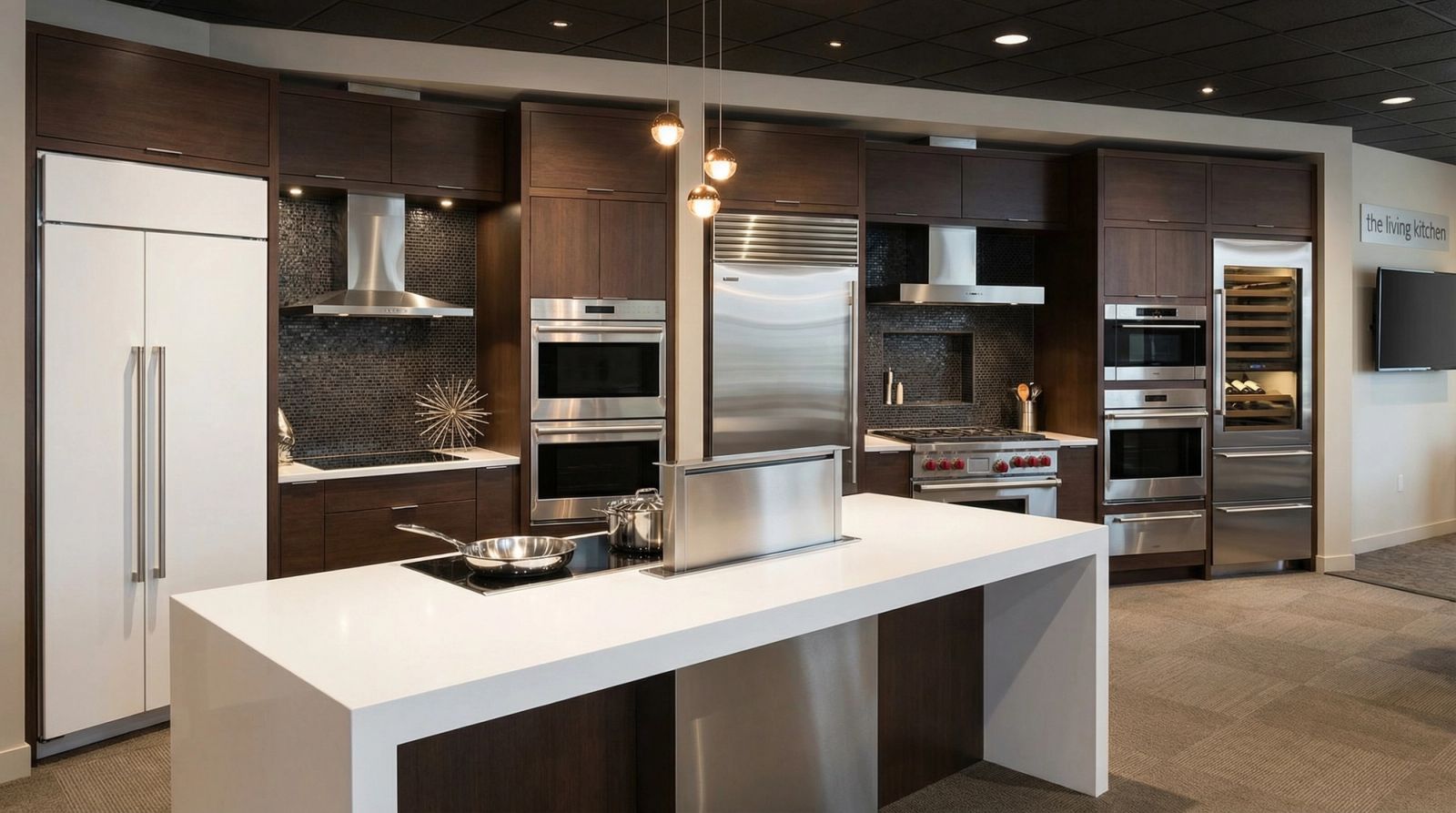
Kitchen displays feature working appliances customers can open, inspect, and sometimes operate. Refrigerator interiors get examined dozens of times daily. Range controls get tested. Dishwasher racks get pulled in and out. This hands-on evaluation provides information impossible to capture in product descriptions.
Bedroom and dining displays showcase how furniture scales in actual room settings, helping customers visualize pieces in their homes.
Each display item serves dual purposes:
- Sales tool - Helps customers evaluate and ultimately purchase (often ordering new versions for delivery)
- Inventory asset - The physical item itself has value and will eventually be sold
The lifecycle of a showroom display:
Month 1-3: New display, pristine condition, heavy customer interaction as people evaluate for purchase
Month 4-8: Established display, light wear accumulating (cushion compression, minor surface contact marks, fabric settling)
Month 9-12: Mature display showing moderate wear, still functional and presentable but clearly used
Month 12+: Older display ready for replacement, condition varies from good to fair depending on traffic level and care
When displays reach the end of their useful showroom life—or when retailers need space for new inventory—they transition from marketing tools to discounted inventory. This is when floor models become floor samples: items available for purchase at substantial discounts.
Why Displays Have Predictable Lifespans
Showroom displays aren't permanent installations. Several factors drive regular turnover:
Seasonal merchandising cycles: Furniture retailers refresh displays twice annually to showcase seasonal collections. Spring/summer displays feature lighter fabrics, brighter colors, and outdoor furniture. Fall/winter displays emphasize cozy textures, rich tones, and layered styling. These seasonal resets create predictable waves of floor sample availability in March-April and September-October.
New product launches: When manufacturers release updated furniture lines or new appliance models, retailers need showroom space to display them. Previous models become floor samples even if they've only been displayed for 3-6 months.
Style evolution: Design trends shift continuously. What looked current 12 months ago may feel dated now. Retailers refresh displays to maintain contemporary appeal, moving older styles to floor sample inventory.
Wear accumulation: Heavy customer interaction eventually leaves visible marks. When displays show enough wear to detract from their effectiveness as sales tools, they're replaced with fresh pieces.
Discontinuations: When manufacturers discontinue product lines, retailers cannot reorder matching inventory. Remaining display pieces become final-sale floor samples.
The key insight: Floor samples exist because showroom displays serve time-limited purposes. Once that purpose is fulfilled—either through natural wear, seasonal changes, or product updates—the items need to sell to recover value and make room for new displays.
What "Floor Sample" Actually Means in Practice
Floor sample is a descriptor, not a condition grade. It indicates the item's history (used as a showroom display) but doesn't specify exact condition, which can range from excellent to fair depending on multiple factors:
Display location matters:
- High-traffic main aisle displays: More customer interaction, more wear
- Back corner or elevated platform displays: Less handling, better condition
- Window displays: Possible sun fading, otherwise minimal wear
- Protected displays (roped off, display-only): Minimal wear despite long display periods
Display duration matters:
- 3-6 months: Usually excellent condition, minimal visible wear
- 6-9 months: Very good condition, light wear on contact surfaces
- 9-12 months: Good condition, moderate wear visible but acceptable
- 12+ months: Fair to good condition, significant wear possible
Showroom care matters:
- Premium retailers with protective measures: Better condition preservation
- High-volume discount retailers: Heavier wear from more customer traffic
- Climate-controlled environments: Better fabric and finish preservation
- Regular cleaning and maintenance: Maintains appearance longer
Product type matters:
- Durable materials (leather, solid wood, metal): Show less wear
- Delicate materials (light fabrics, soft finishes): Show more wear
- Simple designs (minimal moving parts): Fewer failure points
- Complex mechanisms (recliners, sleepers, adjustable bases): More wear potential
The same "floor sample" label can describe a sectional in nearly new condition after four months of protected display and a sofa in fair condition after fifteen months of heavy traffic—both legitimately classified as floor samples, but with dramatically different value propositions.
This variability is why in-person inspection is critical and why understanding inspection methodology (covered in depth later) separates smart floor sample purchases from regrettable mistakes.
Why Retailers Discount Floor Samples (And How Much)
Floor samples represent a specific inventory challenge for retailers: valuable assets that have served their display purpose and now need to convert to cash and free showroom space. Understanding retailer motivations clarifies why discounts are substantial and genuine.
The Economics of Showroom Space
Retail square footage is expensive, especially in high-visibility shopping areas where furniture stores locate. Every square foot displaying a mature floor sample is space that could showcase new, higher-margin inventory.
Cost structure example:
A furniture retailer in a suburban shopping district might pay $25-40 per square foot annually in rent. A sectional display occupies approximately 120 square feet (including surrounding walking space). That display costs the retailer $3,000-4,800 annually just in rent, plus utilities and climate control.
If that sectional sits as a display for 12 months generating sales of new equivalent models, the rent cost is justified. But once it's time to replace the display with a new collection, keeping the old display costs money while contributing diminishing sales value. The retailer's incentive is to convert it to cash quickly and install new displays that drive fresh sales.
This creates genuine pricing pressure—not artificial "sale" pricing but real economic motivation to move floor samples efficiently.
Inventory Capital Tied Up
Beyond rent, floor samples represent capital investment retailers need to recover:
When a retailer purchases inventory from manufacturers for display purposes, that capital is tied up until the item sells. A $3,000 wholesale-cost sectional displayed for 10 months represents $3,000 of working capital unavailable for other inventory purchases.
Floor sample sales at 40-50% off retail still allow retailers to recover costs and generate modest profit:
- Wholesale cost: $3,000
- Original retail price: $6,000
- Floor sample sale price: $3,600 (40% off retail)
- Retailer gross profit: $600
This $600 profit is less than the $3,000 they'd make selling the item new at full retail, but it's acceptable because:
- The item already served its purpose as a sales-generating display
- Recovering $3,600 is better than holding inventory indefinitely at ongoing storage cost
- The space can now display new inventory with higher profit potential
Retailers don't discount floor samples because items are damaged or defective—they discount because the economics favor converting mature displays to cash rather than continuing to hold them.
Seasonal Inventory Pressure
Furniture and home goods retail operates on pronounced seasonal cycles creating predictable clearance pressure:
Spring refresh (March-April):
- Retailers clear heavy winter furniture: dark leathers, traditional wood pieces, rich upholstery
- New spring lines arrive: lighter fabrics, contemporary designs, outdoor collections
- Floor sample availability peaks as winter displays make room for spring merchandising
Fall refresh (September-October):
- Summer inventory clears: outdoor furniture, bright colors, casual pieces
- Fall collections arrive: layered textiles, warm tones, formal dining and living room furniture
- Second annual peak of floor sample availability
These seasonal transitions create concentrated periods where retailers list multiple high-quality floor samples simultaneously—often providing the best selection and deepest discounts of the year.
Seasonal pricing dynamic:
- Outdoor sectional listed as floor sample in May (peak season): 30-35% off
- Same sectional quality listed in October (off-season): 50-60% off
- Retailers discount more aggressively when demand timing doesn't favor holding inventory
Strategic shoppers time major purchases around counter-seasonal clearances: buying outdoor furniture in fall/winter and indoor furniture during off-peak months.
Model Year Changes and Product Launches
Appliances and some furniture categories operate on annual model year cycles similar to automobiles:
Appliance model years typically turn over in late spring/early summer:
- New refrigerator, range, washer, and dryer models launch May-July
- Previous year models become "outdated" even if functionally identical
- Retailers need showroom space to display current year models
- Previous year floor models get discounted 15-35% despite being virtually identical to new models
Furniture manufacturers launch new collections on varying schedules:
- Major manufacturers often introduce lines at furniture markets (April and October)
- Retailers receive new inventory 1-3 months after market introductions
- Floor samples of previous collections must clear to accommodate new displays
The functional reality: Model year changes often involve cosmetic updates rather than substantive improvements. A 2024 refrigerator and a 2025 refrigerator might differ only in control panel styling or handle finish—capacity, efficiency, and features remain identical.
Value opportunity: Floor models from previous model years deliver current functionality at substantial discounts. A $2,800 floor model refrigerator from last year's line performs identically to this year's $3,200 model with updated aesthetics.
Discontinuations Create Final Clearance
When manufacturers discontinue furniture lines, finishes, or appliance models, retailers face a specific challenge: no reorder capability.
If a customer sees a discontinued floor sample sofa and wants to special-order a new one in different fabric, the retailer cannot fulfill that order. The floor model becomes the only available piece, creating final-sale urgency.
Discontinued floor sample pricing typically runs 50-70% off original retail because:
- Retailer cannot hold inventory hoping for special orders
- Matching inventory no longer available (customer cannot buy matching chairs for a discontinued dining table)
- Item occupies space needed for orderable, current-line inventory
For shoppers, discontinued floor samples offer exceptional value if the specific piece meets needs—but come with the limitation that you cannot change your mind and order a different size, fabric, or configuration later.
Typical Savings by Category: What to Expect
Floor sample discounts vary significantly by product category based on display wear patterns, warranty implications, and retailer practices. Understanding category-specific expectations helps assess whether pricing is fair.
Furniture Floor Samples
Upholstered Furniture (Sofas, Sectionals, Chairs, Ottomans):
Typical discount range: 35-55% off retail
Factors affecting discount depth:
- Fabric type: Delicate fabrics (velvet, linen) show more wear and justify deeper discounts than durable fabrics (leather, performance fabric)
- Display duration: 6 months = 35-40% off; 12+ months = 50-55% off
- Cushion condition: Minimal compression = smaller discount; significant settling = larger discount
- Brand positioning: Premium brands (Restoration Hardware, Room & Board) maintain value better than mass-market brands
What you're getting at 40% off:
- Frame and construction identical to new pieces
- Fabric showing light wear (possible minor pilling, subtle fading, compression on seat cushions)
- All functionality intact (cushions, frame, legs)
- Immediate availability fully assembled
Red flag pricing:
- Under 30% off for upholstered floor samples suggests insufficient discount for used condition
- Over 65% off suggests significant undisclosed condition issues or pricing manipulation
Wood Furniture (Dining Tables, Dressers, Beds, Desks, Shelving):
Typical discount range: 30-50% off retail
Factors affecting discount depth:
- Finish durability: Hardwood with quality finish shows minimal wear; soft wood with thin finish shows more
- Display handling: Dressers with frequently opened drawers show more wear than display-only shelving
- Surface condition: Tables used for display staging may have rings or marks; purely structural pieces remain pristine
- Construction quality: Solid wood maintains value better than veneer or composite materials
What you're getting at 40% off:
- Solid construction with normal structural integrity
- Finish showing light scratches, possible minor dings on edges or corners
- All drawers, doors, and hardware functional
- May need minor cleaning or polish to restore appearance
Premium wood furniture floor samples often represent exceptional value: A solid walnut dining table from a quality manufacturer at 45% off delivers better construction and longevity than a new veneer table from a budget brand at full price.
Metal and Glass Furniture:
Typical discount range: 25-40% off retail
These materials show less wear than upholstery or wood:
- Metal frames: Light surface marks or scuffs but structural integrity unaffected
- Glass tops: Minor cleaning needed but material doesn't degrade from display use
- Smaller discounts reflect better condition preservation
Appliance Floor Models
Major Kitchen Appliances (Refrigerators, Ranges, Dishwashers):
Typical discount range: 10-25% off retail
Discount variation factors:
- Cosmetic damage: No visible damage = 10-15% off; minor dings/scratches = 20-25% off
- Display duration: Newer floor models command premium pricing
- Model year: Current year = smaller discount; previous year = larger discount
- Feature complexity: Smart appliances and premium models maintain value better
What you're getting at 15% off:
- Fully functional appliance, often with manufacturer warranty
- Possible fingerprints, minor surface marks from customer handling
- Interior showing signs of opening/closing but no use
- All racks, shelves, and accessories included (verify this)
Appliance floor samples different from furniture: Most appliances displayed in showrooms are never installed or operated beyond basic demonstrations. They're essentially new items that have been opened and handled, not used items with wear from actual operation.
Scratch-and-Dent Appliances (Subset of Floor Samples):
Typical discount range: 30-50% off retail
When appliances sustain cosmetic damage during display or delivery (dent on side panel, scratched door), they enter scratch-and-dent category:
- Functionality completely unaffected
- Damage usually on sides or back that will face walls
- Warranty often still applies
- Deep discounts because retailer cannot sell as "pristine"
Value opportunity: Scratch-and-dent appliances for built-in installations (where damaged sides won't be visible) offer exceptional value—50% savings with zero functional compromise.
Laundry Appliances (Washers, Dryers):
Typical discount range: 10-20% off retail
Similar dynamics to kitchen appliances but:
- Less customer handling than refrigerators (fewer openings of doors and drums)
- Often in excellent cosmetic condition
- Manufacturer warranties typically intact
Lighting and Light Fixtures
Typical discount range: 25-45% off retail
Lighting floor samples include:
- Chandeliers and pendant lights displayed in vignettes
- Table and floor lamps used in furniture displays
- Decorative lighting showing style and finish options
Condition considerations:
- Wiring and electrical components: Should be unused and safe
- Finish and materials: May show dust accumulation or minor handling marks
- Bulbs and shades: Verify all components present
Lighting floor samples offer strong value because:
- Display use doesn't affect functionality
- Materials (metal, glass, fabric shades) show minimal degradation
- Often designer or premium brands at accessible prices
Mattresses and Bedding
Typical discount range: 30-50% off retail
Mattress floor samples are controversial and vary by retailer:
"Display-only" mattresses (never slept on, used only for sitting/touching):
- 30-40% off retail
- Often come with same warranty as new
- Condition similar to new with possible compression from customers sitting on edges
"Actual demo" mattresses (customers lie down for testing):
- 40-50% off retail
- More significant use and compression
- Warranty often reduced or as-is
- Sanitation concerns for some buyers
Mattress floor sample considerations:
- Verify whether warranty applies (critical for long-term value)
- Assess your comfort with "used" mattresses (even light display use)
- Inspect for stains, odors, or structural issues
- Understand retailer sanitation practices
Many buyers prefer new mattresses for hygiene reasons despite steep floor sample discounts—this is a personal comfort decision.
Outdoor Furniture and Patio Sets
Typical discount range: 40-60% off retail
Outdoor furniture floor samples show highest discount variability:
Indoor showroom displays of outdoor furniture:
- 40-45% off retail
- Minimal weather exposure
- Condition similar to other furniture floor samples
Outdoor display areas or seasonal showrooms:
- 50-60% off retail
- Possible sun fading, weather exposure, outdoor wear
- Functionality intact but cosmetic condition may be significantly compromised
Seasonal timing dramatically affects pricing:
- Peak season (April-June): 35-45% off
- Off-season (September-February): 55-65% off
Outdoor furniture represents extreme value in counter-seasonal shopping: Buying in October for next spring's use captures deepest discounts when retailers urgently clear inventory.
Home Décor and Accessories
Typical discount range: 25-45% off retail
Floor sample décor includes:
- Mirrors, artwork, and wall décor used in vignettes
- Decorative objects and accessories
- Rugs displayed in showrooms
- Planters, vases, and styling elements
Condition generally excellent:
- Most décor receives minimal handling
- Materials don't degrade from display
- Primary issue is dust accumulation or minor handling marks
Décor floor samples offer straightforward value: Items that enhance displays get sold at material discounts when displays refresh, with condition nearly identical to new.
Floor Sample vs. Open-Box vs. Overstock: Understanding the Differences
Shoppers often encounter these three categories treated interchangeably in marketplace listings, but they represent fundamentally different products with distinct implications for condition, pricing, and risk.
Floor Sample vs Open-Box vs Overstock: At-a-Glance
Here’s how the three most common discount categories compare when you’re shopping locally.
Floor Samples (Showroom Displays)
- Condition: Good to excellent with light cosmetic wear from display
- Typical Discount: 30–60% off retail
- Warranty: Limited or partial remaining (varies by brand)
- Risk Level: Moderate
- Returns: Usually final sale
Best for shoppers who want the biggest savings and are comfortable with minor cosmetic imperfections.
Open-Box Items (Customer Returns)
- Condition: Ranges from like-new to lightly used
- Typical Discount: 20–40% off
- Warranty: Variable or unclear
- Risk Level: Moderate to high
- Returns: Often final sale
Best for buyers who want near-new condition and are willing to inspect carefully.
Overstock Inventory (New Surplus)
- Condition: Brand-new and unused
- Typical Discount: 20–35% off
- Warranty: Full manufacturer coverage
- Risk Level: Low
- Returns: Standard return policies
Best for shoppers who prioritize warranty protection and low risk.
Why This Matters
Understanding these differences helps you balance price, condition, and long-term value—so you don’t overpay for “new” or underestimate the value of a clean floor model.
Floor Samples: What Makes Them Distinct
Definition: Items used as showroom displays for customer evaluation, typically 3-12 months before being sold.
Pros:
- Significant discounts (35-55% typical for furniture)
- Premium brands become affordable
- Known history (displayed in showroom, not used in home)
- Immediate availability
- Condition is visible and assessable in person
- Often higher quality than budget new items at similar price points
Cons:
- Visible cosmetic wear expected
- One-of-a-kind (cannot buy matching pieces later)
- Limited or no warranty coverage for furniture
- Usually final sale with no returns
- Requires in-person inspection to verify acceptable condition
Best use cases:
- Budget-conscious quality seekers
- Immediate furniture needs
- Buyers comfortable with minor imperfections
- Items for secondary spaces (guest rooms, offices, rental properties)
See Floor Sample vs Open-Box vs Overstock for comprehensive comparison.
Open-Box: The Variable Wild Card
Definition: Customer returns, briefly displayed items, or packaging-damaged products that cannot be sold as new.
The challenge with open-box: Condition variability is extreme. One open-box sofa might be pristine (customer ordered wrong size, never used), while another might be moderately worn (customer used for three months before returning).
Open-box subcategories:
- Like-new: Never used, packaging damaged only
- Minimal use: Briefly installed/used before return
- Light use: Several weeks to months of use
- Moderate use: Extended use before return
Pros:
- Sometimes near-new condition at 25-35% discounts
- May retain full or partial warranty
- Occasionally includes items still in protective packaging
Cons:
- Condition highly unpredictable
- Warranty status often unclear
- Return reasons may indicate product issues
- Usually final sale or limited return windows
- Requires thorough verification of condition and history
Best use cases:
- Buyers who can inspect in person before purchase
- Items with clear return history (wrong size, color error)
- Appliances with professional inspection documentation
- Situations where like-new condition at moderate discount is the goal
Overstock: New but Excess
Definition: Brand-new, unused inventory retailers ordered in excess of demand.
Why overstock exists:
- Seasonal over-ordering
- Discontinued models being replaced
- Color/finish variations proving less popular
- Bulk purchase excess
Pros:
- New condition with no use or wear
- Full manufacturer warranty
- Standard return policies often apply
- Predictable condition (new)
- Sometimes available in quantities (can buy matching sets)
Cons:
- Smaller discounts than floor samples (25-35% typical)
- May be discontinued models with limited future parts support
- Previous-year models may have outdated features
- Retailers may inflate "retail price" to exaggerate discount
Best use cases:
- Buyers prioritizing warranty coverage
- Need for multiple matching items
- Low risk tolerance
- Appliances where warranty protection matters
Which Category Offers Best Value?
No universal answer—value depends on priorities:
Maximize savings + accept wear = Floor samples
Floor samples deliver deepest discounts on quality brands. If you're comfortable with light cosmetic wear and want premium construction at accessible prices, floor samples offer exceptional value.
Want near-new + willing to verify = Open-box
Open-box can deliver nearly new items at moderate discounts if you carefully verify condition and history. Requires more due diligence than other categories.
Prioritize warranty + low risk = Overstock
Overstock provides peace of mind through new condition and full warranty, though at smaller discount percentages.
Strategic approach: Use all three categories selectively
- Floor samples for furniture in low-visibility locations or where cosmetic wear doesn't matter
- Open-box for specific finds that you can thoroughly inspect
- Overstock for appliances where warranty coverage is critical
Understanding these distinctions prevents comparing incompatible items: A floor sample at 45% off isn't "better" than overstock at 30% off—they're different value propositions serving different needs.
How to Inspect Floor Samples Like a Professional Buyer
Professional furniture buyers, interior designers, and retail quality inspectors use systematic evaluation protocols when assessing floor samples. These techniques separate genuinely good deals from items that are cheap for good reasons.
The Pre-Inspection Mindset
Before examining any floor sample, establish your acceptance threshold:
Ask yourself: "What level of cosmetic wear is acceptable for this item's intended use and location?"
Centerpiece furniture for main living spaces: Minimal wear acceptable (excellent to very good condition)
Functional furniture for secondary spaces: Moderate wear acceptable (good condition)
Utilitarian items or rental properties: Significant wear acceptable if price reflects it (fair condition)
This threshold guides your inspection—you're not looking for perfection; you're assessing whether condition aligns with price and your tolerance level.
Furniture Floor Sample Inspection Protocol
Step 1: Overall visual assessment from 6 feet
Stand back and view the piece from normal room distance:
- Does it look acceptable at this distance?
- Are there obvious stains, damage, or color issues?
- Does the piece present well overall?
If it fails this test, don't proceed—condition is too compromised for your needs.
Step 2: Frame and structural integrity examination
For upholstered furniture:
- Sit on every seating position (all sofa cushions, each chair)
- Rock gently side-to-side to test for wobbling or looseness
- Listen for creaking, groaning, or unusual sounds indicating stressed joints
- Press down on arms and backs to assess firmness and structural integrity
- Lift one corner slightly off the ground to test overall stability
For wood furniture:
- Press down on table surfaces to test for flex or instability
- Open and close all drawers multiple times
- Drawers should glide smoothly without sticking
- Drawer fronts should align properly when closed
- No unusual resistance or binding
- Open and close all doors, checking hinges and alignment
- Examine joints for gaps, separation, or visible repairs
- Check legs for stability and levelness
Red flags:
- Excessive wobbling that can't be fixed with simple leveling
- Creaking under normal pressure (indicates loose or stressed joints)
- Drawers that bind, stick, or come off tracks
- Visible cracks in wood frames or legs
- Previous repair attempts (mismatched screws, glue residue, added brackets)
Step 3: Cushion and upholstery assessment
Cushion testing:
- Remove all cushions and examine separately
- Press down firmly on each cushion
- Observe recovery time when you release pressure
- Excellent: Cushion returns to shape within seconds
- Good: Cushion returns slowly but fully
- Fair: Cushion shows permanent compression
- Poor: Cushion doesn't recover, remains compressed
Upholstery inspection:
- Run your hand across all fabric surfaces feeling for texture changes
- Look for pilling (small fabric balls) on high-contact areas:
- Arms and armrests
- Front edges of seat cushions
- Back cushion areas where bodies contact
- Examine seams and stitching for separation or fraying
- Check for stains under bright light (some only visible in certain lighting)
- Assess color consistency (sun fading creates variation)
- Smell for odors (smoke, pet, mildew, chemical)
Acceptable wear for floor samples:
- Light cushion compression with good recovery
- Minor pilling on arms and seat fronts
- Slight fabric settling or texture change
- Small, faint surface marks or light soiling
Concerning wear:
- Permanent cushion compression with no recovery
- Extensive pilling covering large areas
- Visible stains that won't clean
- Strong odors indicating absorption of smoke or pet smells
- Tears, snags, or fabric damage
Step 4: Finish and surface examination
For wood furniture:
- Inspect finish quality under good lighting
- Look for scratches, gouges, or worn areas
- Check for water rings or heat marks on surfaces
- Examine edges and corners for dings or chips
- Assess uniformity of finish (blotchy areas indicate poor maintenance)
For metal and glass:
- Look for scratches, scuffs, or surface damage
- Check for rust or corrosion on metal
- Examine glass for chips or cracks
- Assess coating or finish condition
Step 5: Hardware and mechanisms verification
Test all functional components:
- Recliner mechanisms: Operate through full range smoothly
- Sleeper sofa mechanisms: Extend and retract bed platform
- Adjustable components: Test all positions
- Table extension mechanisms: Extend and collapse table
- Drawer pulls and handles: Verify secure attachment
- Casters and wheels: Check smooth rolling and locking
Verify all hardware present:
- Count cushions against specifications
- Check for all decorative pillows if mentioned in listing
- Confirm table leaves included for extendable tables
- Verify all bolts, connectors, and assembly hardware present
Step 6: Underside and hidden area inspection
This step separates thorough inspection from casual review:
For upholstered furniture:
- Flip furniture or look underneath base
- Examine frame construction and materials
- Look for frame damage, cracks, or previous repairs
- Check leg attachment points for security
- Verify no structural damage hidden by upholstery
For wood furniture:
- Look at back panels (often lower quality than fronts)
- Check drawer bottoms and sides
- Examine internal construction
- Look for manufacturer labels and information
Step 7: Photography and documentation
Before accepting any floor sample:
- Photograph from all angles
- Capture close-ups of any disclosed damage or wear
- Document overall condition
- Take pictures of manufacturer labels and information
This documentation protects you if condition disputes arise and provides records of accepted condition.
Appliance Floor Model Inspection Protocol
Step 1: Exterior cosmetic assessment
Examine all visible surfaces:
- Front panels and doors for scratches, dents, or damage
- Sides and top (even if they'll face walls, verify claimed condition)
- Control panels for cracks, scratches, or worn buttons
- Handles for secure attachment and finish condition
Document any cosmetic damage:
- Is it consistent with disclosed condition?
- Will it be visible in your installation?
- Does pricing reflect the damage level?
Step 2: Functional verification
Power and basic operation (where possible in showroom):
- Confirm unit powers on
- Check that all indicator lights function
- Verify displays show properly
- Test control responsiveness
For refrigerators:
- Open and close all doors multiple times
- Doors should close smoothly and seal properly
- Gaskets should make contact all around perimeter
- No unusual resistance or sticking
- Operate all drawers and shelves
- Smooth sliding motion
- Secure attachment
- Check interior lighting
- Listen for compressor operation if unit is plugged in
For ranges and ovens:
- Test all burner controls (smooth rotation, good resistance)
- Operate oven door (smooth opening, secure latching)
- Pull out oven racks (should slide smoothly)
- Check control panel functionality
For washers and dryers:
- Rotate drum manually (smooth rotation, no resistance)
- Open and close door (secure latching, good seal)
- Test control dial or panel (responsive inputs)
- Check interior drum for damage or rust
For dishwashers:
- Pull out racks (smooth operation)
- Examine spray arms (should rotate freely)
- Check door seal condition
- Test door latch
Step 3: Interior condition assessment
Examine appliance interiors thoroughly:
- Look for rust, corrosion, or deterioration
- Check for staining or residue
- Verify all components present (racks, shelves, drawers)
- Assess cleanliness
For appliances, interior condition often reveals history: Pristine interiors suggest display-only use. Stained or marked interiors suggest heavier demonstration or possible previous installation.
Step 4: Component and accessory verification
Confirm all items that should be included:
- All racks, shelves, and drawers
- User manual (or ability to download digital version)
- Warranty documentation
- Installation hardware (hoses, cords, mounting brackets)
- Specialized accessories (ice makers, water filters, specialty racks)
Missing components reduce value: A refrigerator missing $200 worth of shelves should be priced $200 lower than complete units.
Step 5: Model information and specification verification
Record complete model information:
- Manufacturer and brand
- Full model number
- Serial number
- Manufacture date (if visible)
Use this information to:
- Research current retail pricing
- Verify specifications match listing
- Confirm warranty status
- Check for recalls or known issues
Step 6: Warranty status clarification
Ask retailer to verify warranty coverage:
- Is manufacturer warranty intact?
- When does coverage start (at your purchase or when it was first placed on display)?
- How much coverage time remains?
- Are there limitations or exclusions for floor models?
For appliances, warranty status significantly affects value. Full warranty justifies paying more; no warranty requires deeper discount.
Red Flags That Should Stop the Purchase
Structural or functional issues:
- Frames that wobble excessively or show instability
- Mechanisms that don't operate smoothly
- Drawers or doors that bind or won't close properly
- Unusual sounds indicating mechanical problems
- Appliances that won't power on or show error codes
Undisclosed or hidden damage:
- Condition significantly worse than photos or description suggested
- Damage in areas that weren't photographed
- Seller downplaying obvious issues
- Stains or wear that seller claims "will clean up" but likely won't
Missing critical components:
- Hardware, cushions, or accessories not mentioned as missing in listing
- Table leaves, bed rails, or essential structural elements absent
- Appliance racks or shelves gone without disclosed
Concerning history or vague answers:
- Seller cannot explain how long item was on display
- Conflicting information about condition or warranty
- Evasive responses to direct questions
- Pressure to purchase without thorough inspection
When you encounter red flags, walk away. There will be other floor samples, and avoiding one bad purchase saves more money than jumping on a problematic deal.
Warranty, Returns, and Protection: What Actually Applies
Understanding warranty coverage and return options for floor samples is critical because policies differ dramatically from new retail purchases—and assumptions about coverage cause frequent disputes.
Furniture Floor Sample Warranty Reality
The general rule: Most furniture floor samples are sold "as-is" with limited or no warranty coverage.
Why furniture warranty coverage is limited:
Furniture manufacturer warranties typically begin on the date of first sale or delivery. For floor samples:
Scenario 1: Warranty never started (most favorable)
- Some manufacturers extend full warranty to floor sample buyers
- Less common but occasionally offered by premium brands
- Verify this explicitly—don't assume
Scenario 2: Warranty started when displayed
- Item placed on showroom floor 10 months ago
- 5-year frame warranty on original sale
- Remaining warranty at your purchase: 50 months
- You receive partial coverage, not full warranty
Scenario 3: Warranty already expired
- Item displayed long enough to exceed warranty period
- Sold completely as-is with no coverage
- Price should deeply discount to reflect zero protection
Manufacturer defect vs. wear and tear:
Even when warranty applies, understand what's covered:
Typically covered:
- Manufacturing defects in materials or construction
- Frame failures or structural issues arising from production defects
- Hardware failures (springs, mechanisms) due to manufacturing problems
Not covered:
- Cosmetic wear from showroom use
- Cushion compression or fabric wear
- Normal use deterioration
- Damage caused during transport or in-home use after purchase
Furniture warranty value is limited even when present because most issues with floor samples are cosmetic rather than structural.
Appliance Floor Model Warranty Nuances
Appliances have more favorable warranty dynamics than furniture:
Many appliance floor models retain manufacturer warranty because:
- They've been displayed but not installed or operated
- Manufacturer treats them similarly to new items
- Warranty often starts at your purchase date, not display date
Verify warranty status explicitly:
Questions to ask the retailer:
- "Does this floor model come with manufacturer warranty?"
- "When does the warranty period start—at my purchase or when it was displayed?"
- "How many years/months of coverage do I receive?"
- "Can you provide warranty documentation?"
For appliances, warranty presence or absence significantly affects value:
Floor model refrigerator with 2-year manufacturer warranty at 20% off: Strong value—close to new functionality with warranty protection
Same refrigerator with no warranty at 20% off: Questionable value—insufficient discount for assuming all repair risk
Fair pricing guideline: Appliances with no warranty should discount 35-50% to compensate for risk.
Scratch-and-dent appliance warranties:
Cosmetic damage doesn't typically void manufacturer warranties if the appliance was never installed:
- Dent on refrigerator side panel: Warranty usually applies
- Scratch on range top: Warranty usually applies
- Damage to control panel or operational components: Warranty may be voided
Always confirm warranty status on scratch-and-dent items—don't assume cosmetic damage disqualifies coverage.
Extended Warranty Considerations
Retailers often offer extended warranties for additional cost:
For floor samples, extended warranty evaluation is complex:
When extended warranties add value:
- Floor model has minimal or no remaining manufacturer warranty
- Appliance is expensive (refrigerators, ranges over $1,500)
- Complex features or smart technology that could fail
- You plan to keep the item 7-10+ years
When extended warranties don't justify cost:
- Furniture (floor samples already discounted, extended warranty adds cost back)
- Items with substantial manufacturer warranty remaining
- Low-cost items where warranty cost approaches replacement cost
- Simple appliances with few failure points
Extended warranty cost-benefit calculation:
Example: Floor model refrigerator at $1,800
- Extended 5-year warranty: $350
- Total cost: $2,150
Alternative approach:
- Don't buy warranty, save $350
- Self-insure by setting aside $350 for potential repairs
- If no repairs needed in 5 years, you keep the money
Many buyers find self-insurance more economical than extended warranties, but risk tolerance varies.
Return Policy Realities
Floor samples typically have restrictive return policies:
Common return policy structures:
Final sale, no returns or exchanges (most common):
- Once purchased, item is yours regardless of fit or satisfaction
- No recourse for buyer's remorse
- Inspection before purchase is critical
Exchange only within 7-14 days:
- Can exchange for other floor samples or store credit
- No cash refunds
- Limited selection for exchanges
Return with restocking fee (uncommon):
- 15-25% restocking fee deducted from refund
- Must return in same condition as sold
- Time window often 7-14 days
Why restrictive returns are standard:
- Item is already discounted (retailer margin is thin)
- One-of-a-kind inventory (can't just return to stock)
- Condition assessment becomes disputed (was wear there at sale?)
What "as-is" really means:
As-is sales indicate:
- No warranty coverage
- No return options
- Buyer assumes all risk
- Price should reflect this (typically 50%+ discounts for true as-is sales)
As-is doesn't mean "broken" or "defective"—it means the retailer provides no guarantees beyond what you verified during inspection.
Protection Strategies for Floor Sample Purchases
Given limited warranty and return options, protect yourself through:
Thorough pre-purchase inspection:
- Catch all issues before accepting the item
- Document condition with photos
- Test all functionality
- Verify all components present
Realistic condition expectations:
- Expect cosmetic wear consistent with display use
- Don't buy floor samples if you need perfection
- Accept minor imperfections as trade-off for savings
Payment method protection:
- Credit cards offer purchase protection and dispute resolution
- Some cards extend manufacturer warranties automatically
- Documentation of transaction helpful if disputes arise
Immediate post-purchase testing:
- For appliances, install and test within days of purchase
- Document any issues immediately
- Contact retailer quickly if problems appear
- Some retailers work with buyers on issues discovered within reasonable timeframes even on final-sale items
Transportation care:
- Proper transport prevents damage you'll be responsible for
- Use appropriate vehicles, equipment, and techniques
- Inspect immediately after transport for any transit damage
The fundamental insight: Limited warranty and returns make pre-purchase verification critical. You cannot rely on post-purchase recourse the way you can with new retail purchases, so get it right before committing.
Real Risks of Floor Sample Purchases (And How to Avoid Them)
Floor samples offer genuine value, but they carry risks that new retail purchases don't. Understanding these risks and implementing mitigation strategies separates successful floor sample shopping from costly mistakes.
Risk 1: Hidden Wear Not Visible in Photos or Casual Inspection
The problem:
Showroom displays receive thousands of customer interactions over months. Some wear is visible; some is subtle and only becomes apparent after living with the item:
Cushion compression that appears acceptable in the store but feels uncomfortably flat after daily use at home
Fabric pilling that looks minor under showroom lighting but bothers you under home lighting where you see it daily
Mechanical wear in recliners or adjustable furniture that operates smoothly during brief testing but develops issues with regular use
Odor absorption (showroom fragrances, cleaning chemicals) that becomes noticeable in your home
Mitigation strategies:
Extended inspection time:
- Spend 15-20 minutes with floor samples, not 2-3 minutes
- Sit on sofas in multiple positions
- Open drawers and doors repeatedly, not just once
- Test mechanisms through full range of motion several times
Ask about display location and duration:
- "How long has this been on your showroom floor?"
- "Was this in a high-traffic area or lower-traffic section?"
- "Was this near windows where sun exposure could cause fading?"
Assess wear in context:
- Light wear after 4 months suggests quality construction
- Moderate wear after 4 months suggests either heavy traffic or lower durability
- Moderate wear after 12 months is expected and acceptable
Set realistic expectations:
- Floor samples will have some wear—that's why they're discounted
- The question is whether wear level is acceptable for the price
- If you need pristine condition, buy new
Risk 2: Missing Components or Hardware
The problem:
Floor samples sometimes lose pieces during display period:
Decorative pillows get separated from sofas
Table extension leaves get stored separately and forgotten
Appliance racks and shelves get removed for display purposes and not returned
Hardware bags (for assembly) get misplaced
User manuals get discarded or filed away
Remote controls for adjustable furniture get lost
Missing components reduce value—sometimes significantly. A dining table missing its two extension leaves is substantially less useful than the complete set.
Mitigation strategies:
Verify completeness before purchase:
- "Are all cushions, pillows, and components included?"
- "Does this table include all extension leaves?"
- "Are all appliance racks, shelves, and accessories present?"
- "Is the user manual available, or can I download it?"
- "Is assembly hardware included if needed?"
Count and check physically:
- Don't trust verbal assurances—physically count cushions, leaves, and components
- Look for manufacturer documentation showing what should be included
- Cross-reference against online product specifications
Negotiate price adjustments for missing items:
- "This is missing two decorative pillows. The replacement cost is $120. Can we adjust the price by $120?"
- "The appliance is missing one shelf. Can you source a replacement or reduce the price?"
Document what's missing:
- Photograph and note missing components
- Get written acknowledgment from retailer
- Understand whether missing pieces affect functionality or just completeness
Risk 3: No Return Options After Purchase
The problem:
Final-sale floor samples cannot be returned if:
The piece doesn't fit your space (measurements were incorrect or you misjudged scale)
The color looks different in your home than it did in the showroom
The comfort level isn't what you expected after using it for a week
You change your mind or your design plans shift
New retail purchases have 30-90 day return windows—floor samples typically don't. This places all responsibility on the buyer to make the right decision upfront.
Mitigation strategies:
Measure everything before purchase:
- Verify item dimensions match your space requirements
- Measure doorways, hallways, and delivery path (see Will It Fit? Complete Measuring Guide)
- Account for clearances around furniture
Assess color and finish in multiple lighting:
- If possible, visit showroom at different times of day
- Take color samples or photos to compare with your home
- Understand that showroom lighting differs from home lighting
Test thoroughly during inspection:
- Spend significant time sitting on furniture
- Test all positions and configurations
- Assess whether comfort level meets your needs
- Don't rush this evaluation
Accept the commitment:
- Final sale means you're committed to the purchase
- If you have any doubts, don't buy
- Better to pass on a questionable deal than live with regret
Some retailers work with dissatisfied buyers even on final-sale items—but don't count on this. Make the right decision upfront rather than hoping for accommodation later.
Risk 4: Transport and Delivery Damage
The problem:
Floor samples sit assembled in showrooms. When you pick them up or arrange delivery, they must be disassembled, transported, and reassembled—each step creating damage risk:
Scratches during loading into vehicles
Structural stress from improper handling or positioning
Finish damage from inadequate padding during transport
Component loss if parts aren't secured properly
Damage during disassembly or reassembly if you're unfamiliar with the process
You own the item at pickup—any subsequent damage is your responsibility, not the retailer's.
Mitigation strategies:
Use appropriate vehicles and equipment:
- Rent trucks or vans large enough to accommodate items without forcing
- Use furniture blankets, straps, and padding
- Bring dollies or hand trucks for heavy items
Recruit sufficient help:
- Two people minimum for most furniture
- Three or four people for large sectionals or heavy items
- Professional movers if item exceeds your capability
Document condition at pickup:
- Photograph items before loading
- Note any existing damage
- This protects you from seller claims that you caused damage
Follow proper transport techniques:
- Secure items so they don't shift during transport
- Pad all surfaces that contact other items
- Drive carefully, avoiding sudden stops or sharp turns
Consider professional delivery for valuable items:
- Floor samples worth $2,000+ may justify $150-300 professional delivery
- Reduces damage risk and removes physical burden
See Why Local Pickup Beats Shipping for complete pickup preparation guidance.
Risk 5: Discontinued Models and Parts Availability
The problem:
Many floor samples are from discontinued product lines. This creates potential long-term issues:
For furniture:
- Cannot buy additional matching pieces later (can't add a second chair to go with the floor sample chair you bought)
- Replacement parts (specific hardware, cushions with exact fabric) may be unavailable
- Repair services may not support discontinued lines
For appliances:
- Replacement parts may have limited availability
- Service technicians less familiar with older models
- Software updates unavailable for smart appliances
- Energy efficiency may be lower than current models
Mitigation strategies:
Verify discontinuation status:
- "Is this model discontinued, or is it still in the manufacturer's current line?"
- "If parts are needed in the future, will they be available?"
- "Does the manufacturer still service this model?"
Research parts availability:
- Search online for replacement parts for the specific model
- Check manufacturer parts diagrams and availability
- Assess whether common failure items (motors, controls, seals) are still obtainable
Accept limitations:
- Discontinued furniture means you cannot expand the collection
- Buy everything you need at once if you want matching pieces
- Understand that repairs may be more difficult in 5-10 years
For some purchases, discontinued status doesn't matter:
- A one-time furniture piece that doesn't need matching items
- Durable goods unlikely to need parts (solid wood tables, metal shelving)
- Items you'll replace before parts become issue
For others, it's a dealbreaker:
- Appliances where you want long-term parts support
- Furniture collections where you might add pieces later
- Complex items where discontinued parts would make repairs impossible
Risk 6: Pricing Based on Inflated "Retail" Numbers
The problem:
Some retailers inflate "original retail price" to make discounts appear larger than they are:
Listed as: "Floor sample sectional, retail $4,500, now $2,700 (40% off!)"
Reality: That sectional never actually sold for $4,500. The typical market price was $3,200-3,500. The "40% discount" is actually 15-23% off real street pricing.
This doesn't necessarily mean the floor sample is overpriced—$2,700 might be fair for the condition—but it means the "savings" are exaggerated.
Mitigation strategies:
Research actual market pricing:
- Search for the exact model number to find current retail pricing
- Check multiple retailers to establish true market price
- Look at sale pricing (not just MSRP) since furniture is often on sale
Calculate discount from real baseline:
- If market pricing is $3,200-3,500, and floor sample is $2,700
- Real discount: 15-23% off typical retail
- Assess whether this discount is fair for the condition
Focus on absolute price, not percentage:
- "Is $2,700 a fair price for this sectional in this condition?"
- Forget the percentage discount and evaluate actual value
- Compare to other options at similar price points
Be skeptical of extreme discount claims:
- "70% off" floor samples are rare and suggest either extraordinary circumstances or pricing manipulation
- 35-55% discounts are typical for furniture floor samples
- Anything significantly outside this range warrants scrutiny
How Professionals Shop Floor Samples
Interior designers, furniture retailers, home stagers, and professional buyers use specific strategies when evaluating and purchasing floor samples. Understanding their approach provides insight into maximizing value.
The Designer's Value Calculation
Interior designers purchase floor samples for client projects and their own inventories using different evaluation criteria than retail consumers:
Quality-to-price ratio takes priority over discount percentage:
Designers know that a floor sample from a premium manufacturer at 45% off represents better long-term value than a new item from a budget brand at full price—even if the total costs are similar.
Key assessment: "What is the quality level per dollar spent?"
Example comparison:
Option A: Floor sample sofa from premium brand
- Original retail: $3,800
- Floor sample price: $2,100 (45% off)
- Construction: Hardwood frame, eight-way hand-tied springs, high-density cushions
- Quality level: Excellent, expected 15-20 year lifespan
Option B: New sofa from mid-tier brand
- Retail price: $2,000
- Construction: Engineered wood frame, sinuous springs, medium-density cushions
- Quality level: Good, expected 8-12 year lifespan
Designer choice: Option A delivers superior quality despite being $100 more expensive. The cost per year of use is lower.
Designers calculate total project cost including floor samples:
- A $2,100 floor sample sofa that needs $200 in professional cleaning and $150 in new throw pillows to be client-ready
- Total cost: $2,450
- Still better value than $3,000 new sofa with lower quality construction
Fabric and finish condition matters more for some projects than others:
- High-end residential: Designers require excellent condition (light wear acceptable, moderate wear rejected)
- Model homes and staging: Good condition sufficient (moderate wear acceptable if priced accordingly)
- Commercial and rental: Fair condition works if pricing is aggressive
The Retail Buyer's Inspection Shortcuts
Professional furniture buyers who source inventory for resale have developed efficient inspection techniques:
The 30-second structural assessment:
- Approach piece and push down firmly on arms/back
- Sit in center seat and rock side-to-side
- Listen for any unusual sounds
- Stand up and observe cushion recovery
If the piece passes these quick tests, proceed to detailed inspection. If it fails, move on immediately.
The component completeness glance:
Experienced buyers can quickly assess whether all components are present:
- Visual count of cushions against typical configurations
- Scan for symmetry (missing pieces create visual imbalance)
- Check drawer/door count matches expected for that furniture type
Missing items are immediately flagged for negotiation or rejection.
The price-to-condition calibration:
Professional buyers maintain internal pricing models:
- Excellent condition floor samples: 35-40% off retail is fair
- Very good condition: 40-50% off retail
- Good condition: 50-55% off retail
- Fair condition: 55-65% off retail
If pricing doesn't align with condition, they walk away—no attachment, no compromise.
The Home Stager's Strategic Purchasing
Home stagers furnish properties for sale and use floor samples extensively:
Stagers prioritize:
Visual impact over comfort:
- A floor sample sofa needs to look good in listing photos
- Actual sitting comfort matters less than for residential buyers
- Moderate cushion compression acceptable if piece photographs well
Neutral, versatile pieces:
- Floor samples in neutral colors (grays, beiges, whites) have broader staging applications
- Trendy colors or bold patterns limit usability across different properties
Easy transport and setup:
- Modular pieces or items that disassemble easily
- Lightweight construction (for frequent moving between properties)
- Durable finishes that withstand repeated transport
Extreme value focus:
- Stagers seek 50-60% discounts because items will be moved repeatedly and wear quickly
- Lower condition thresholds than designers because items won't be in one location permanently
Stager strategy: Buy deeply discounted floor samples in good-to-fair condition, use for staging 2-3 properties, then sell or donate.
Professional Timing Strategies
Experienced floor sample shoppers know when inventory peaks:
End-of-month timing:
- Retailers face monthly sales targets
- Final days of the month see additional discounting pressure
- Floor samples that have sat for 2+ weeks get price reductions
Post-holiday clearances:
- January (after holiday season)
- Late February to early March (before spring resets)
- Late August to early September (before fall resets)
New showroom openings:
- Retailers opening new locations often clear old showroom inventory
- Multiple high-quality floor samples list simultaneously
- Urgency to clear creates negotiation opportunities
Going-out-of-business sales:
- Maximum urgency to liquidate
- Deepest discounts but typically final-sale, as-is terms
- Inspection critical as there's no recourse after purchase
Professional buyers build relationships with retailers:
- Frequent shoppers get advance notice of upcoming floor sample availability
- Retailers may hold desirable pieces for regular customers
- Negotiation leverage increases with repeat business
The Professional's Walk-Away Discipline
The most important professional strategy: Knowing when to walk away.
Professionals pass on floor samples when:
The discount doesn't justify the condition:
- 30% off for furniture in fair condition is insufficient
- Price should reflect actual condition, not arbitrary discount percentage
Critical components are missing:
- No negotiation possible on missing items
- Walk away rather than accept incomplete inventory
Condition is worse than described:
- If listing says "excellent condition" but inspection reveals moderate wear
- Dishonesty about condition indicates problematic seller
The piece doesn't meet project needs:
- No compromise on requirements
- Better to wait for right piece than settle for wrong one
Professionals don't fall in love with individual pieces—they evaluate systematically and move on when pieces don't meet criteria. This discipline prevents emotional purchases that look less appealing after the excitement wears off.
Consumer application: Adopt professional detachment. View floor sample shopping as optimization problem: finding best value that meets your specific needs. Don't get attached until you've completed thorough evaluation.
How to Time Your Floor Sample Shopping for Best Deals
Floor sample availability follows predictable patterns tied to retail cycles. Strategic timing increases selection, improves pricing, and raises the probability of finding exactly what you need.
Seasonal Showroom Refresh Cycles
Furniture and home goods retailers operate on biannual display refresh schedules:
Spring refresh (March-April):
What clears:
- Heavy winter furniture (dark leather sofas, traditional wood pieces, rich upholstery)
- Fall/winter color palettes (deep browns, burgundies, forest greens)
- Formal dining and living room furniture from holiday displays
What arrives:
- Light, airy furniture (linen and cotton upholstery, light wood finishes)
- Outdoor and patio furniture
- Contemporary and casual designs
- Spring color palettes (light blues, greens, whites, naturals)
Floor sample strategy: Shop March-April to buy winter furniture at deepest discounts, or wait until May-June if you want spring style floor samples.
Fall refresh (September-October):
What clears:
- Summer outdoor furniture
- Bright, casual pieces
- Light-colored upholstery
- Contemporary minimalist designs
What arrives:
- Cozy, layered furniture (plush upholstery, textured fabrics)
- Rich color palettes (warm browns, deep blues, burgundy)
- Formal dining and entertaining furniture
- Traditional and transitional styles
Floor sample strategy: Shop September-October to buy outdoor furniture at 50-60% off for next year's use, or shop November-December for fall style floor samples.
Counter-seasonal shopping delivers maximum value:
Buying outdoor furniture in October means you're purchasing off-season when retailers desperately need to clear space. You won't use it immediately, but saving 55% instead of 35% makes waiting worthwhile.
Appliance Model Year Transitions
Major appliances follow annual product cycles:
New models typically launch:
- Refrigerators and freezers: May-June
- Washers and dryers: June-July
- Ranges and ovens: May-August
- Dishwashers: June-August
Floor model availability peaks: July-September as retailers make space for current year models
The reality of appliance "updates":
Most annual appliance updates are cosmetic rather than functional:
- New finishes or handle styles
- Updated control panel designs
- Minor capacity adjustments
- Smart connectivity additions (for premium models)
Core functionality—capacity, efficiency, reliability—rarely changes year-over-year.
Value opportunity: Previous year floor models in August-September deliver current functionality at 20-35% discounts, with many retaining manufacturer warranties.
Strategic timing for appliance floor models:
Immediate need: Buy any time, but expect 10-20% discounts
Flexible timing: Wait until July-September model year transition for 20-35% discounts on previous year inventory
Maximum savings: Combine model year transition with holiday sales (Labor Day, Memorial Day) for deepest discounts
Quarterly Sales Pressure and Month-End Clearances
Retail businesses measure performance quarterly, creating predictable discount pressure:
Quarter-end periods (March 31, June 30, September 30, December 31):
Why these matter:
- Store managers have quarterly sales targets
- Pressure to hit targets intensifies in final 2-3 weeks of quarter
- Floor samples that have sat for weeks get price reductions to boost sales numbers
What happens:
- Items listed for 30+ days see 5-15% additional markdowns
- Managers gain authority to negotiate on previously firm pricing
- Urgency increases as quarter-end approaches
Shopping strategy:
- Monitor floor samples during the quarter
- Make offers in final week of quarter on items that haven't sold
- Example: "This has been listed for 5 weeks at $1,800. I can pick up today and pay $1,600."
Month-end pressure (every month):
Similar dynamics occur monthly, though less pronounced than quarter-end:
- Final 3-5 days of month see pricing flexibility
- Items approaching 30 days on floor get reviewed for markdowns
- Managers more willing to accept reasonable offers
Black Friday and major holiday weekends:
Contrary to expectation, major sale weekends are not always best for floor sample deals:
Why:
- Retailers focus promotional energy on new inventory sales
- Showroom traffic is high, reducing urgency to discount floor samples
- Floor sample listings may slow during peak sale periods
Better strategy:
- Shop the week after major sale weekends
- Items that didn't sell during the sale get floor-modeled and listed
- Retailers clear remaining inventory to return to normal operations
Post-holiday clearance periods:
January (post-holiday clearance):
- Peak clearance period for furniture and décor
- Retailers need to clear holiday inventory and make room for spring merchandise
- Floor samples from November-December displays get deep discounts
Late February/Early March:
- Pre-spring clearance accelerates
- Last chance to clear winter floor samples before spring merchandise arrives
- Urgency creates negotiation opportunities
New Store Openings and Relocations
When furniture retailers open new locations or relocate existing stores, floor sample inventory surges:
Why this creates opportunities:
Store remodels:
- Existing location closes temporarily for renovation
- All showroom inventory must clear
- Floor samples from entire store list simultaneously
- Urgency to liquidate creates 55-65% discount opportunities
New location openings:
- Retailers consolidate inventory from multiple locations to new flagship
- Duplicate displays from old locations become floor samples
- Volume of available inventory exceeds normal marketplace levels
Relocations:
- Moving showroom inventory is expensive
- Retailers prefer to sell floor samples and purchase new displays for new location
- Aggressive pricing to avoid moving costs
How to catch these opportunities:
Monitor local business news:
- Search "[your city] furniture store opening"
- Follow local retail real estate news
- Watch for store closure or remodel announcements
Set Google Alerts:
- "furniture store opening [city]"
- "furniture store relocating [city]"
- "furniture store closing [city]"
Follow retailers on social media:
- Stores announce remodels and relocations through social channels
- Often advertise clearance events in advance
Check FLRPL frequently during these periods:
- Verified retailers list floor sample surges on platform
- Volume opportunities rare but valuable when they occur
Pickup, Transport, and Setup: Making It Work
Floor sample purchases typically require self-pickup and transportation. Proper preparation prevents damage, injury, and post-purchase regret.
Pre-Pickup Preparation Checklist
Before scheduling pickup, confirm:
Item dimensions and weight:
- Measure the floor sample (don't rely solely on specifications)
- Note weight from manufacturer specs or ask retailer
- Identify heaviest component for multi-piece items
Your vehicle capabilities:
- Confirm item fits in your vehicle with doors closed
- Account for irregular shapes (sofas with arms, tall dressers)
- Verify weight capacity of vehicle
Doorway and access measurements:
- Measure home doorways, hallways, and staircases
- Verify floor sample will navigate your delivery path
- Plan for removable legs or tilting if needed
- See Will It Fit? Complete Measuring Guide for methodology
Helper availability:
- Recruit appropriate number of helpers for item weight
- Confirm their availability for specific pickup time
- Brief them on item size and handling needs
Equipment and supplies:
- Moving blankets (4-6 minimum)
- Ratchet straps or tie-downs (4-6)
- Dolly or hand truck (rent if you don't own)
- Tools for disassembly if needed (screwdrivers, wrenches)
- Work gloves for grip and hand protection
Vehicle Selection and Rental
Matching vehicle to item requirements:
Small furniture (chairs, nightstands, small tables, lamps):
- Suitable: SUV, minivan, large sedan
- Rental needed: Rarely
- Cost: $0 (personal vehicle)
Medium furniture (sofas, dining tables, dressers, bookcases):
- Suitable: Pickup truck, cargo van, large SUV
- Rental options: U-Haul pickup, Home Depot truck rental
- Cost: $50-100 for half-day rental
Large furniture (sectionals, wardrobes, king beds, large tables):
- Suitable: Full-size pickup, cargo van, 10-foot truck
- Rental options: U-Haul cargo van or 10' truck
- Cost: $75-150 for half-day rental
Appliances (refrigerators, washers, dryers, ranges):
- Suitable: Pickup truck, cargo van with height clearance
- Critical requirement: Appliances must transport upright (especially refrigerators)
- Rental recommendation: Cargo van with 6+ feet interior height
- Cost: $75-150
Rental tips:
Choose pickup location wisely:
- Rent near the retailer, not near your home
- Minimizes empty driving miles
- Verify rental location hours match your pickup schedule
Understand mileage and time limits:
- Some rentals include limited miles; others charge per mile
- Late return fees escalate quickly
- Build time buffer into reservation
Inspect rental vehicle:
- Verify cargo area is clean and dry
- Check that straps/tie-downs are available
- Test tailgate/door operation before loading
Essential Equipment and Materials
Core equipment for any furniture or appliance pickup:
Moving blankets:
- Protect finishes from scratches during loading and transport
- Create padding between items
- Prevent shifting damage
- Quantity needed: 4-6 blankets for typical pickup
- Available: Rental $10-15 or purchase $40-80 for reusable set
Ratchet straps or tie-downs:
- Secure items to prevent movement during transport
- Use multiple straps for large items
- Verify weight rating appropriate for your load
- Quantity needed: 4-6 straps
- Cost: $20-40 for set (reusable)
Furniture dolly or hand truck:
- Essential for appliances and heavy furniture
- Dramatically reduces injury risk
- Available at truck rental locations
- Rental: $10-15 per day
Work gloves:
- Protect hands from splinters, sharp edges, and friction
- Improve grip on smooth surfaces
- Cost: $10-20
Optional but helpful:
Furniture sliders:
- Ease movement across floors
- Protect floors from scratches
- Cost: $15-30
Moving straps or lifting harness:
- Distribute weight across body for safer lifting
- Reduce back strain
- Cost: $30-50
Tools for disassembly:
- Screwdrivers (Phillips and flathead)
- Allen wrench set
- Adjustable wrench
- Useful for removing legs, disassembling tables, or taking apart bed frames
Proper equipment investment:
- Rental approach: $40-75 for single use
- Purchase approach: $150-300 for reusable kit
- If you shop floor samples regularly, purchasing equipment makes sense
Safe Loading and Transportation Technique
Professional loading methodology:
Step 1: Prepare and protect the item
For upholstered furniture:
- Remove all loose cushions and transport separately
- Wrap entire piece in moving blankets
- Secure blankets with tape or straps
- Protect arms and corners with extra padding
For wood furniture:
- Remove drawers and transport separately (reduces weight, prevents shifting)
- Wrap in blankets focusing on edges and corners
- Protect glass tops with cardboard and blankets
For appliances:
- Remove all racks, shelves, and internal components
- Transport internal components separately
- Tape doors closed (but don't use strong tape on finishes)
- Wrap in blankets
Step 2: Load in proper sequence
Loading order:
- Heaviest items first, against front of cargo area
- Longest items along sides of vehicle
- Medium items in center
- Lightest items on top or in gaps
- Loose components and removed pieces last
Weight distribution:
- Place weight over vehicle axles when possible
- Avoid loading all weight on one side
- Lower center of gravity reduces shifting risk
Step 3: Secure everything
Strapping technique:
- Attach straps to vehicle anchor points
- Use multiple straps per item (minimum 2 for large pieces)
- Create downward and lateral pressure to prevent shifting
- Test security by pushing on items—they shouldn't move
Verification test:
- After securing everything, push firmly on all items
- Walk around vehicle checking for any movement
- Retighten any straps that have loosened
Step 4: Drive carefully
Transportation best practices:
- Avoid sudden acceleration or braking
- Take corners slowly and smoothly
- Drive under speed limit, especially with top-heavy loads
- Check mirrors frequently to monitor load
- Stop after 5-10 minutes to verify nothing has shifted
Special considerations for appliances:
Refrigerators absolutely must remain upright:
- Laying refrigerators on sides damages compressors
- If tilting is unavoidable, tilt backward (not side-to-side)
- Keep tilt angle under 45 degrees if possible
- Wait 24 hours before plugging in if refrigerator was tilted
Washers and dryers:
- Upright position preferred for both
- Washers can lay on backs if necessary (drain any water first)
- Dryers should remain upright
- Secure drums to prevent internal movement
Unloading and Setup
Unloading sequence:
Reverse the loading order:
- Remove lightest items first
- Work toward heaviest items last
- This prevents having to lift/move heavy items over other furniture
Inspect immediately for transit damage:
- Before bringing items into home, verify no damage occurred
- Document any issues with photos
- Contact retailer immediately if damage is discovered
Direct placement when possible:
- Bring items to their final rooms rather than staging in garage or living room
- Reduces number of moves and subsequent handling damage
Reassembly and setup:
Furniture reassembly:
- Reattach legs, reconnect sectional pieces, or reassemble tables
- Use photos taken during disassembly as reference
- Don't overtighten hardware (strip prevention)
- Verify stability after reassembly
Appliance installation:
- Follow manufacturer instructions for installation
- Level appliances (especially refrigerators and washers)
- Connect water lines, gas lines, or venting properly
- Test operation before considering installation complete
Floor protection:
- Use furniture pads under legs to prevent floor scratching
- Place appliances on appropriate surfaces (washers on level concrete or reinforced floors)
- Verify adequate clearance for ventilation
Final quality check:
- Sit on furniture to verify stability
- Open drawers and doors to confirm proper operation
- Test appliance functions
- Assess whether item meets your expectations in your space
Common post-pickup issues and solutions:
Item doesn't fit through doorway:
- Remove door from hinges for extra clearance
- Try diagonal maneuvering
- Remove furniture legs if possible
- Consider returning if truly won't fit (if return policy allows)
Damage discovered during unloading:
- Document with photos immediately
- Contact retailer same day
- Most retailers won't accept responsibility but some work with buyers
- This is why pre-purchase inspection is critical
Item looks different in your home:
- Lighting differs from showroom (expected)
- Scale may feel different in your specific space
- Give yourself a few days before deciding if it works
- Final-sale terms mean you own it—make it work if possible
Who Should Buy Floor Samples (And Who Shouldn't)
Floor samples aren't right for everyone or every situation. Understanding when floor samples make sense versus when paying full price for new items is the better choice prevents purchase regret.
Ideal Floor Sample Buyers
Budget-conscious quality seekers:
Profile: Want premium brands and quality construction but can't afford full retail pricing
Why floor samples work:
- Access brands like Restoration Hardware, Room & Board, Crate & Barrel at 40-60% off
- Better construction and materials than budget brands at similar total cost
- Willing to accept light cosmetic wear for significant savings
Example scenario: Can afford $1,500 for living room seating. Options:
- New budget-brand sofa for $1,500: Engineered wood frame, average cushions, 5-8 year lifespan
- Floor sample premium-brand sofa for $1,500 (retail $3,000): Hardwood frame, quality cushions, 12-18 year lifespan
The floor sample delivers better value per dollar and per year of use.
Immediate need shoppers:
Profile: Broken appliance, new home, or urgent furniture need with no time to wait for shipping
Why floor samples work:
- Same-day to 3-day availability vs. 4-12 weeks for new furniture shipping
- Skip delivery delays and supply chain uncertainties
- Can see and take home immediately
Example scenario: Refrigerator fails on Monday. Options:
- Order new online: 2-4 week delivery, $2,200, can't verify condition until arrival
- Buy floor model locally: Pick up Wednesday, $1,850, inspected before purchase
Floor model solves the urgent need faster and cheaper.
Secondary space furnishers:
Profile: Furnishing guest bedrooms, home offices, basements, rental properties, or vacation homes
Why floor samples work:
- Cosmetic wear matters less in low-visibility or secondary spaces
- Guests or tenants care more about functionality than pristine appearance
- Budget can stretch further when buying floor samples
Example scenario: Furnishing a guest bedroom that's used 15 days per year
- Guest won't notice or care about light cushion compression on floor sample bed
- Saving $800 on floor sample bedroom set vs. new makes economic sense
Sustainable and environmentally conscious buyers:
Profile: Prefer extending product lifecycles, reducing waste, and shopping sustainably
Why floor samples work:
- Keeps quality furniture in use rather than being discarded
- Reduces demand for new manufacturing
- Local pickup eliminates shipping environmental impact
- Extends life of well-made items that have years of use remaining
Design-savvy shoppers with flexible aesthetics:
Profile: More concerned with quality and value than having the latest trend or specific color
Why floor samples work:
- Access to discontinued styles and finishes often representing timeless design
- Willing to adapt design plans around available inventory
- Appreciate quality craftsmanship over trendiness
Professional buyers (designers, stagers, rental property owners):
Profile: Purchasing for business use where quality-to-cost ratio matters most
Why floor samples work:
- Maximize budget efficiency
- Understand how to evaluate condition professionally
- Can absorb cosmetic wear into business model
- High volume purchasing makes finding deals worthwhile
When to Skip Floor Samples and Buy New
Perfectionists and pristine-condition requirement:
Profile: Any visible wear or imperfection causes dissatisfaction
Why floor samples don't work:
- Light cosmetic wear is expected in floor samples
- Even excellent-condition floor samples show some signs of use
- Dissatisfaction outweighs savings if you constantly notice imperfections
Better choice: Pay full price for new items in perfect condition
Centerpiece furniture for main living areas (for some buyers):
Profile: The sofa, dining table, or statement piece is the focal point of your most-used space, and you're particular about appearance
Why floor samples may not work:
- You'll see the piece daily for years
- Minor wear that seemed acceptable in showroom may bother you at home
- Pristine appearance matters more for highly visible centerpieces
Consideration: Premium floor samples in excellent condition can work, but be honest about your tolerance
Warranty-priority appliance buyers:
Profile: Complex or expensive appliances where long-term warranty protection is critical
Why some floor samples don't work:
- Appliance floor models with no remaining warranty require you to assume all repair risk
- Smart appliances, high-end refrigerators, or complex systems with expensive repairs need warranty coverage
Better choice: New appliances with full warranty, or floor models that retain manufacturer warranty
Exception: Floor models with remaining warranty are fine
Need for matching furniture pieces:
Profile: Want to buy dining table now and add chairs later, or buy one chair and purchase more later
Why floor samples don't work:
- Floor samples are one-of-a-kind
- Cannot reorder matching pieces
- Cannot buy additional units to expand collection
Better choice:
- Buy current-line new furniture you can reorder
- Or buy complete floor sample sets when available
Gift givers:
Profile: Purchasing furniture or appliances as gifts
Why floor samples may not work:
- Recipients may prefer new items in pristine condition
- Giving "used" items (even lightly used) may not convey appropriate sentiment
- Return/exchange options limited if recipient doesn't like the piece
Better choice: New items with standard return policies and gift receipts
Exception: Close family or friends who value savings over pristine condition
Buyers unable to inspect in person:
Profile: Shopping remotely without ability to visit showroom and inspect before purchase
Why floor samples don't work:
- Condition assessment from photos alone is unreliable
- Cannot verify completeness or test functionality
- Final-sale terms combined with inability to inspect is high-risk
Better choice:
- Only buy floor samples you can inspect in person
- For remote shopping, choose new items with robust return policies
The Decision Framework
Ask yourself these questions:
- "Will minor cosmetic wear bother me?"
- No → Floor samples are viable
- Yes → Buy new or only consider excellent-condition floor samples
- "Do I need warranty protection?"
- Yes → Verify warranty status; avoid floor samples with no coverage
- No → Floor samples work fine
- "Might I need matching pieces later?"
- Yes → Buy new from current lines
- No → Floor samples are fine
- "Can I inspect in person before buying?"
- Yes → Floor samples are viable
- No → Avoid floor samples
- "Is this for a high-visibility centerpiece or secondary space?"
- Centerpiece → Consider carefully; require excellent condition
- Secondary → Floor samples work well
If you answer favorably to 4-5 questions, floor samples are likely right for you. If you answer unfavorably to 3+ questions, buying new makes more sense.
How FLRPL Makes Floor Sample Shopping Smarter and Safer
The traditional challenges with floor sample shopping—discovery, verification, and transaction confidence—are solved through platforms purpose-built for this market.
The Discovery Problem FLRPL Solves
Historical floor sample shopping required:
Store-by-store visits:
- Driving to multiple furniture retailers
- Asking each about floor model availability
- No guarantee they'd have anything
- Time-intensive with low hit rate
Phone calls to dozens of retailers:
- Calling stores individually
- Asking about specific categories
- Getting vague or incomplete information
- No way to compare across retailers
Random luck:
- Stumbling across floor samples by chance
- No systematic way to find inventory
- Missing deals because you didn't happen to visit at the right time
FLRPL centralizes floor sample discovery:
Browse available inventory in one place:
- See floor samples from multiple verified retailers
- Compare options across stores without visiting each
- Filter by category, location, price, and condition
Save time and expand reach:
- What previously required visiting 10 stores over a weekend now happens in 30 minutes of browsing
- Access retailers you might not have thought to visit
- Discover stores in your area you didn't know existed
Save searches and receive alerts:
- Define exactly what you're looking for
- Get notified when matching floor samples appear
- Never miss relevant inventory
Verified Retailer Network
FLRPL exclusively works with verified brick-and-mortar retailers:
What verification means:
- Confirmed business license and operating credentials
- Physical showroom or warehouse location
- Customer reviews and reputation tracking
- Professional retail standards
Why this matters:
Versus peer-to-peer marketplaces:
- No individual sellers with unknown reliability
- No uncertainty about whether seller is legitimate business
- Established retailers have reputational stakes
Versus unverified listings:
- Every retailer has been vetted
- Physical locations you can visit
- Business accountability
See Why "Near Me" Searches Lead to Better Deals for detailed comparison of local retail advantages.
Transparent Listing Standards
FLRPL requires consistent, high-quality listing information:
Real photos of actual items:
- Not stock manufacturer images
- Multiple angles showing true condition
- Close-ups of any wear or damage
- Exactly what you'll see when you visit
Detailed condition descriptions:
- Specific notes about cosmetic wear
- Disclosure of any damage or issues
- Honest assessment of condition grade
Clear pricing transparency:
- Original retail MSRP shown
- Current floor sample price
- Discount percentage calculated
- No hidden fees or surprises
Warranty and return information:
- Explicitly stated for each listing
- No ambiguity about coverage or policies
- Clear before you commit to purchase
Complete specifications:
- Exact dimensions
- Model numbers for research
- Included components listed
- Missing items disclosed upfront
Direct Retailer Communication
Message retailers through the platform:
Ask specific questions before visiting:
- "Can you provide additional photos of the cushion wear?"
- "Is this model discontinued, and will parts be available?"
- "What's your return policy for this floor sample?"
Coordinate pickup logistics:
- Schedule pickup times
- Discuss delivery options if available
- Clarify what you need to bring
Negotiate when appropriate:
- "I can pick up today. Would you consider $1,500 instead of $1,650?"
- Professional communication through platform
Build relationships with preferred retailers:
- Follow stores that offer quality inventory
- Get notified of new listings first
- Become recognized customer for better service
Local Focus and Pickup Coordination
FLRPL emphasizes local transactions:
Location-based search:
- Set radius from your location
- See only floor samples within practical pickup distance
- Focus on deals you can actually access
Pickup verification:
- Items physically located at retailer showrooms or warehouses
- You can visit to inspect before buying
- Same-day to 3-day pickup typical
- See Why Local Pickup Beats Shipping for advantages
This local focus creates advantages:
- Inspect floor samples in person before committing
- Verify condition matches listing descriptions
- Ask questions face-to-face
- Eliminate shipping damage risk
- Support local businesses in your community
Review and Accountability System
FLRPL maintains review system for retailers:
Shoppers can rate:
- Listing accuracy (did item match description?)
- Communication quality (responsive and helpful?)
- Transaction smoothness (pickup well-organized?)
- Overall satisfaction
Reviews help:
- Future shoppers identify trustworthy retailers
- Retailers maintain quality standards
- Platform ensure consistent experience
Accountability mechanisms:
- Retailers know reviews are public
- Poor experiences damage retailer reputation
- Incentives align toward accurate listings and good service
Category Clarity
FLRPL clearly differentiates floor samples from other inventory:
Category labels:
- Floor Sample / Display Model
- Open-Box Return
- Overstock / New Surplus
- Scratch-and-Dent
This clarity prevents:
- Confusion about what you're buying
- Misunderstanding about expected condition
- Comparing incompatible items
Each category has distinct implications (see Floor Sample vs Open-Box vs Overstock for complete comparison)
The Platform Advantage for Smart Shopping
FLRPL doesn't eliminate the need for inspection or evaluation—it makes finding, evaluating, and purchasing floor samples more efficient:
Time savings:
- 30 minutes of browsing > 6 hours of store visits
Expanded reach:
- Access 20+ retailers' inventory > visiting 3-4 stores
Better information:
- Consistent listing standards > variable in-store information
Transaction confidence:
- Verified retailers, clear policies > unknown sellers, unclear terms
Ongoing opportunity:
- Saved searches, alerts > random discovery
The platform model works because it solves real friction in the floor sample market: Discovery is hard, verification is time-consuming, and transaction confidence requires retailer legitimacy. FLRPL addresses all three.
Common Floor Sample Myths Debunked
Misconceptions about floor samples prevent shoppers from accessing genuine value. Correcting these myths helps make informed decisions.
Myth 1: "Floor samples are beat up and low quality"
Reality: Most floor samples are in very good to excellent condition with minor cosmetic wear.
Why this myth persists:
- People assume "used as display" means "heavily used"
- Negative bias toward anything not "brand new"
- Occasional poorly maintained floor samples create generalizations
The truth:
- Premium retailers protect displays and maintain them carefully
- Light wear (cushion compression, minor surface marks) is common
- Heavy damage is rare and priced accordingly when it exists
- Quality construction often means floor samples from good brands show less wear than expected
What to remember: Floor sample condition varies. Inspect before buying, but don't assume all floor samples are damaged.
Myth 2: "You can't get a warranty on floor samples"
Reality: Warranty status varies by category and specific item—some floor samples have substantial coverage.
Furniture floor samples:
- Often sold as-is (true)
- Some premium brands extend warranties to floor sample buyers
- Structural warranties may still apply even if fabric warranties don't
- Varies by manufacturer and retailer
Appliance floor models:
- Frequently retain manufacturer warranty
- Many appliances displayed but never installed still receive full warranty treatment
- Warranty starts at your purchase for some floor models
- Always verify, but coverage is common
What to remember: Don't assume no warranty—ask explicitly and verify status before purchase.
Myth 3: "Floor sample shopping is too much hassle"
Reality: Whether floor sample shopping is "worth it" depends on your priorities and the size of savings.
What's true:
- Requires inspection before purchase
- Usually involves self-pickup and transport
- Needs more due diligence than clicking "buy now" online
What's also true:
- Saves 30-60% on furniture (hundreds to thousands of dollars)
- Immediate availability vs. weeks of shipping delays
- Inspection actually reduces risk (you see before buying)
Value calculation:
For a $2,000 purchase saving $800 (40% off):
- Inspection time: 30 minutes
- Pickup coordination: 1 hour
- Transportation: 2 hours
- Total time investment: 3.5 hours
- Savings per hour of effort: $228/hour
That's excellent return on time invested for most buyers.
What to remember: "Hassle" is subjective. For significant savings, most buyers find floor sample shopping very worthwhile.
Myth 4: "Floor samples are just clearance items retailers couldn't sell"
Reality: Floor samples are displays that served marketing purposes—not unsold inventory that failed in the market.
Why this myth is wrong:
- Floor samples were placed on display intentionally as sales tools
- They help customers evaluate products and make buying decisions
- Many were selling successfully (customers ordered new versions)
- They're removed because displays need refreshing, not because they're unpopular
The actual reason floor samples get sold:
- Seasonal showroom refreshes
- New model introductions
- Space needs for incoming inventory
- Natural display lifecycle completion
What to remember: Floor samples are working displays that completed their marketing purpose, not failed products.
Myth 5: "You're better off buying new on sale"
Reality: This depends entirely on specific comparisons—sometimes yes, sometimes no.
When new on sale beats floor samples:
- Sale price on new is within 10-15% of floor sample pricing
- Warranty coverage important for your needs
- Zero tolerance for any cosmetic wear
- Need for matching pieces you'll order later
When floor samples beat new on sale:
- Floor sample discount is 40-60% vs. sale discount of 20-30%
- Floor sample is premium brand vs. sale item is budget brand
- Immediate availability matters (floor samples today vs. sale items in 4-6 weeks)
- Inspection advantage outweighs warranty difference
Example comparison:
Option A: New mid-tier sofa on sale
- Regular: $2,000
- Sale: $1,600 (20% off)
- Warranty: Full manufacturer
- Timeline: 6-week delivery
Option B: Floor sample premium sofa
- Regular: $3,200
- Floor sample: $1,800 (44% off)
- Warranty: Partial remaining (2 years of 5-year)
- Timeline: Pick up today
Value assessment:
- Option B costs $200 more but delivers significantly better construction
- Better quality per dollar despite higher absolute price
- Immediate availability
- Partial warranty still provides reasonable protection
For many buyers, Option B is better value despite the myth that "sale prices always beat floor samples."
What to remember: Compare specific options, not generalizations. Sometimes new on sale wins; sometimes floor samples win.
Myth 6: "Floor samples are only for people with tight budgets"
Reality: Smart shoppers across all income levels buy floor samples to maximize value.
Who actually buys floor samples:
- Budget-conscious buyers stretching dollars
- Wealthy buyers who appreciate value (not wasting money matters at any income)
- Interior designers furnishing client projects
- Professional buyers for rental properties
- Home stagers building inventory
- Anyone who'd rather spend money on experiences than paying full retail for furniture
Value consciousness isn't poverty:
- Saving $1,500 on furniture means $1,500 for travel, experiences, or investments
- Getting premium quality at accessible prices is smart regardless of income
- Why pay full retail when you can get the same quality for 50% less?
What to remember: Floor sample shopping is about value optimization, not financial desperation.
Myth 7: "All floor sample 'discounts' are fake—retailers inflate prices"
Reality: Some retailers inflate MSRPs, but legitimate floor sample discounts are verifiable.
How to verify real discounts:
- Research the exact model number's actual market pricing
- Check multiple retailers for current sale prices
- Compare floor sample price to true street pricing, not MSRP
- Calculate whether discount reflects the actual condition
When discounts are real:
- Floor sample price is 30-60% below current market pricing
- Discount aligns with condition and warranty status
- Multiple retailers sell the same new item at similar prices higher than floor sample
When discounts are exaggerated:
- MSRP is inflated beyond any real market pricing
- "50% off" floor sample costs the same as or more than current sale prices elsewhere
- Retailer can't justify the stated MSRP with verifiable market data
What to remember: Some pricing manipulation exists, but it's detectable through research. Verify discounts, and many floor samples offer genuine savings.
Final Takeaway: Smart Local Shopping Starts With Understanding
The best furniture and appliance deals in your area aren't hidden on obscure websites or buried in algorithm-driven search results. They're sitting on showroom floors 10-15 miles from your home, serving as displays until seasonal refreshes or new inventory arrivals make them available for purchase at 30-60% discounts.
Floor samples represent a specific value proposition: access to quality brands and premium construction at mid-market or budget prices, in exchange for accepting minor cosmetic wear, conducting thorough pre-purchase inspection, and managing your own pickup logistics.
This trade-off works brilliantly for shoppers who:
- Understand what they're buying and set realistic expectations
- Can distinguish between acceptable showroom wear and problematic damage
- Prioritize quality construction and long-term value over pristine appearance
- Have the capability to manage pickup and transport, or can arrange professional delivery
- Appreciate immediate availability over waiting weeks or months for shipping
Floor samples don't work for shoppers who:
- Need warranty protection above all else and won't verify coverage
- Cannot tolerate any visible imperfection or cosmetic wear
- Require matching pieces they might buy later
- Cannot inspect items in person before purchase
- Expect return options if they change their minds
The knowledge in this guide—understanding retail cycles, inspection methodology, warranty realities, pricing evaluation, and timing strategies—transforms floor sample shopping from risky speculation into systematic value capture.
You now know:
How showrooms work and why displays become available for sale at predictable intervals. What discount ranges are fair for different categories and conditions. How to inspect furniture and appliances like professional buyers. What warranty and return realities apply to floor samples. When seasonal and model-year timing delivers best selection. How to safely pickup, transport, and install floor samples. Which buyers benefit most from floor samples and which should buy new.
This knowledge gives you permanent advantage in furniture and appliance shopping. The next time you need a sofa, dining table, or refrigerator, you have options beyond waiting 8 weeks for shipping or paying full retail at big-box stores.
You can browse verified local retailers on platforms like FLRPL, filter for floor samples matching your needs, evaluate pricing against market rates, coordinate in-person inspection, and bring home quality furniture or appliances the same week—at savings that make the minimal effort absolutely worthwhile.
That's not settling for second-tier products or accepting damaged goods. That's smart local shopping.
The floor samples are already there, in showrooms across your city, priced to move and waiting for buyers who know what to look for. You're now that buyer.
For more guidance on smart local furniture and appliance shopping:
- How to Tell If a Local Deal Is Worth It — Evaluate floor samples and discounted items systematically to avoid bad purchases
- Will It Fit? Complete Measuring Guide — Prevent delivery failures with proper measurement methodology
- Floor Sample vs Open-Box vs Overstock — Understand inventory categories and their value propositions
- Why Local Pickup Beats Shipping — Learn advantages of self-pickup for large furniture and appliances
- How to Find the Best Drops on FLRPL — Discover strategies for finding premium local inventory efficiently
Related Articles
Your Store. Your Merchandise. Your Digital Outlet.
Give your store a digital outlet. See how FLRPL helps local retailers showcase products, share their branded storefront, and connect with nearby shoppers.


You Don't Need Everyone to See It
Local merchandise doesn't need everyone to see it. Explore why proximity, availability, timing, and relevance all matter in local retail discovery.

Not Every Drop Has to Be a Deal
A Drop doesn't require a markdown. See how retailers can use FLRPL to feature new arrivals, seasonal merchandise, distinctive products, deals and more.
Discover What's Waiting Nearby
Browse inventory from verified local retailers near you.

