What to Do When You Find a Real Deal (Before It Disappears)
Found a real deal in-store? Learn how to act quickly and confidently on floor samples, clearance, and overstock items before they disappear. A practical guide for smart buyers.

FLRPL Editorial Team
Author
FLRPL Journal | Buying Intelligence Series
TL;DR
- Real deals are one-off events, not standing inventory — they don’t wait and they don’t restock.
- Hesitation is not irrational. Loss aversion, decision fatigue, and uncertainty are predictable psychological forces that slow even experienced buyers down.
- The buyers who act well are not faster — they are more prepared. The hard decisions get made before they walk in the door.
- A three-question framework can convert vague pressure into a concrete yes-or-no within minutes.
- This logic applies consistently across furniture, appliances, mattresses, flooring, fitness equipment, lighting, and electronics — the category changes, but the decision structure does not.
- FLRPL exists to surface these moments before they expire — but acting on them still requires a buyer who knows what they are looking at.
The Moment You Have Been Waiting For
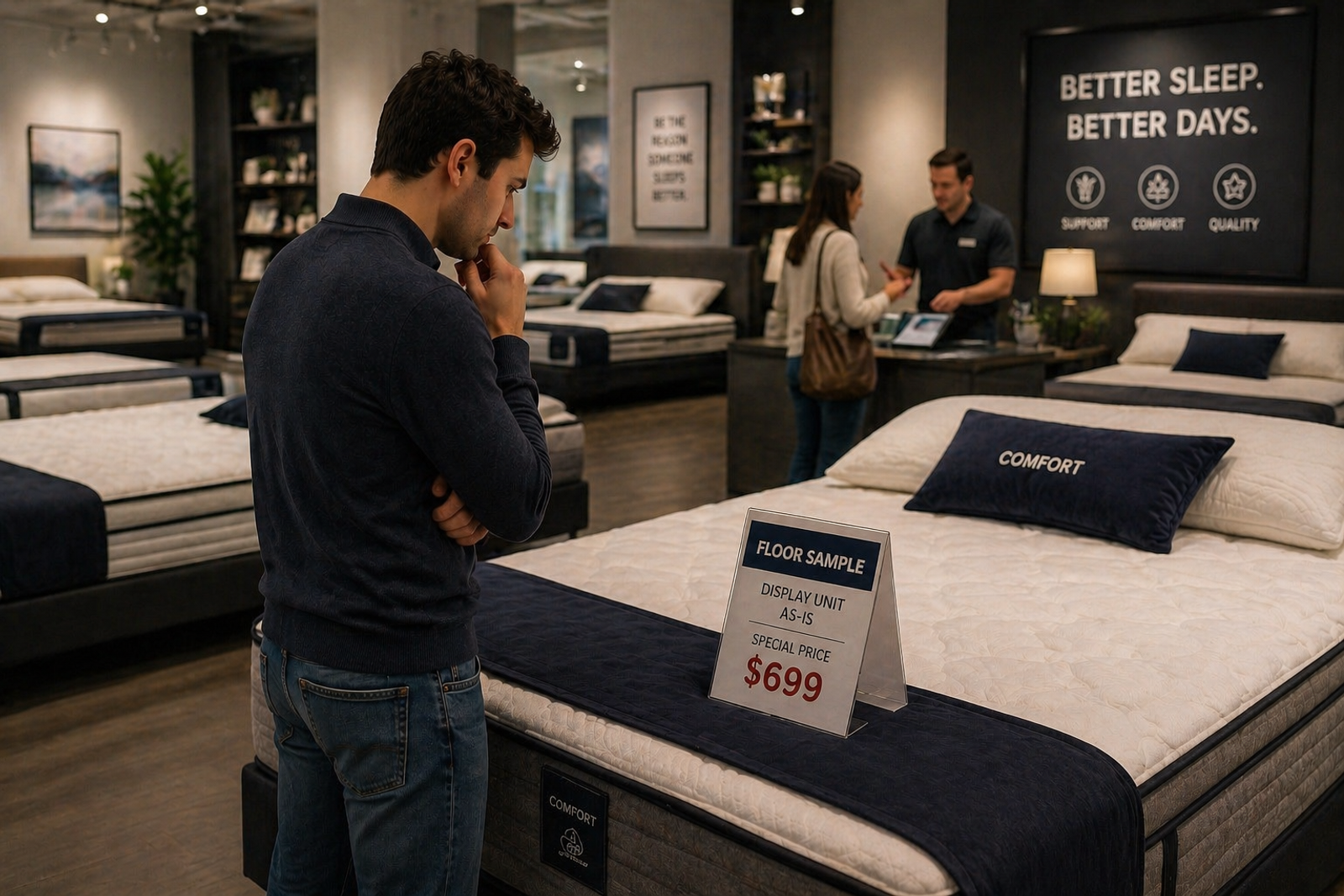
You are halfway through your second lap of the showroom when you see it. The sofa you have been looking for — the right dimensions, the right fabric, a floor sample tag on the arm, and a price that is meaningfully below what you have been tracking online. A salesperson notices you noticing it.
And then, almost immediately, you slow down.
You start asking questions you cannot answer on the spot: Did I measure the doorway or just the wall? Is this the right shade in different lighting? Should I check the other store first? What if something similar goes on sale next month?
This is not a failure of intelligence. It is a completely predictable response to a situation that compresses several competing pressures into a single moment — and understanding why it happens is the first step to handling it better.
Why the Moment Matters More Than You Think
Most shoppers treat a showroom deal as if it will wait for them. It will not.
Deals on floor samples, overstock, and clearance inventory operate under entirely different rules than regular stock. A floor sample exists as a single physical unit. Overstock can move in bulk to a competitor, a liquidator, or another buyer who happened to arrive an hour earlier. A clearance item is, by definition, on its way out of the system — it will not be restocked when it sells, because the retailer's goal is to remove it from the floor entirely.
As explored in "Why Waiting Costs You the Deal," the instinct to circle back later is one of the most reliable ways to lose the specific item you wanted. Physical retail makes availability visible in real time. When you leave the floor, that visibility disappears — and so does any implicit claim you had on the piece.
This is the central distinction that separates a deal worth acting on from one worth thinking about: is this item replenishable, or is this the only one? A salesperson can tell you in thirty seconds whether a product is still in active inventory rotation or whether you are looking at the last unit. That answer should change how you think about the clock.
Why Buyers Still Freeze
Even when a buyer knows an item is scarce, the psychological response to urgency is not always decisiveness — it is often paralysis.
Behavioral research explains this clearly. Loss aversion, the documented tendency to feel the pain of a potential loss more acutely than the pleasure of an equivalent gain, creates a double bind in the showroom. The fear of missing the deal pulls you toward action. The fear of making the wrong purchase pulls you toward delay. Both fears reference loss, which is why neither one simply cancels the other out.
Decision fatigue layers on top of this. By the time a serious buyer reaches a high-value item in a showroom, they have already processed finishes, warranties, dimensions, delivery terms, and financing options. The mental bandwidth required to evaluate one more variable — should I buy this now — often exceeds what is available, and the brain defaults to the less costly-seeming option: wait.
Time pressure makes this worse, not better. Research consistently shows that urgency tends to increase risk sensitivity in shoppers rather than sharpening rational judgment. A limited-time offer does not automatically convert a hesitant buyer into a confident one — it can just as easily convert them into an anxious one who freezes, overthinks, and walks away from something genuinely good.
This is the dynamic that "An Educated Buyer Is a Better Buyer" is built around. Preparation does not eliminate the psychological pressure of the moment — but it dramatically reduces the number of open variables that pressure has to work with.
The Playbook: What to Do When You Find It
This is the section that matters. Here is what a prepared, confident buyer actually does in that moment — not in theory, but in practice.
Step 1: Establish what type of item you are looking at.
Before evaluating price, confirm the inventory classification. Is this a floor sample, a clearance unit, an open-box item, or overstock? As covered in "Where Deals Actually Hide," these categories behave differently and should be evaluated differently. A floor sample may have cosmetic wear but carry a full delivery option. An open-box unit may be pristine but sold as-is. Know what you are buying before you evaluate whether the price is right.
Step 2: Run the three-question test.
This is the most efficient decision tool available in a live retail environment:
- Does it fit — physically, aesthetically, and functionally — in my actual space?
- Is the price meaningfully better than my pre-set budget or research baseline?
- If I walk away today, am I realistically likely to find the same or equivalent item again soon?
If the answers are yes, yes, and no — act. If any answer is genuinely uncertain, move to Step 3 before assuming the answer is no.
Step 3: Resolve the uncertainty, not the anxiety.
Separate uncertainty (missing information) from anxiety (a feeling). Most buyers in the showroom are managing anxiety while calling it uncertainty. If you genuinely do not know whether the item fits, "Will It Fit?" covers exactly how to verify dimensions quickly and confidently. If you are not sure whether the price is strong, "How to Spot a Real Deal in 30 Seconds" walks through the signals that distinguish a real discount from a repositioned retail price.
Ask one specific question: what is the one thing I actually do not know right now? Then answer that thing — and only that thing.
Step 4: Use the store's tools.
Most retailers with genuine clearance inventory will hold an item for a short window — often same-day or 24 hours — if you ask directly. Use that time to confirm one missing detail — not to restart the decision. Ask whether a hold is available. If it is, use it to answer the one open question, not to restart deliberation.
Step 5: Make a bounded decision.
Define acceptable risk before you commit. What is the return or exchange policy? Is there a warranty on the unit? For a misfit piece — an item that did not sell because of a niche spec or unusual dimension — understanding the return terms is especially important, because the retailer's goal is to clear it, not take it back. A bounded decision is one where you know the downside before you commit.
What Not to Do
A few patterns appear repeatedly in buyers who leave the store without a deal they should have taken.
Do not restart your research. Opening a browser in the aisle to compare prices is a form of decision avoidance dressed up as due diligence. If your pre-store research was solid, this behavior adds almost no new information and considerable delay. It also signals to you that you have not yet decided, which makes deciding harder.
Do not compare to hypothetical future deals. "Maybe it goes on sale next month" is only meaningful reasoning when the item is replenishable. For a floor sample or clearance piece, there is no "next month" version of this exact unit. Comparing a real present deal to an imagined future one is not analysis — it is a rationalization for inaction.
Do not loop through the store again. The fifth walk-past rarely produces a new insight. It produces more anxiety. Once you have answered the three questions, additional laps through the showroom are a stall pattern, not a research pattern.
Do not confuse low price with right item. "How to Tell If a Local Deal Is Worth It" makes this distinction clearly. A significant discount on the wrong sofa, the wrong refrigerator, or the wrong flooring lot is still a bad outcome. Price is one variable. Fit, condition, and total cost of ownership — including delivery, installation, and replacement risk — are the others.
The Real Difference Between Fast Buyers and Prepared Buyers
The buyers who handle these moments best are not naturally decisive or unusually risk-tolerant. They are simply finished with the hardest part of the decision before they arrive.
They came in with measurements. They had a budget ceiling and a research baseline. They knew which features were non-negotiable and which were preferences. They had thought through what an acceptable substitute would look like. When they encounter the deal, they are not starting a decision — they are completing one.
Speed is a byproduct of preparation, not a substitute for it. A buyer who sprints to a purchase without that groundwork is making a different kind of mistake — one that shows up later in returns, regret, or incompatibility. The goal is not to be fast. The goal is to be ready.
The Logic Holds Across Every Category
This is not a framework that applies only to furniture. The same structure plays out across every high-ticket category in the showroom.
Furniture: The key questions are fit (dimensions and fabric) and condition (floor sample wear and structural integrity). One-off floor samples in discontinued fabrics or finishes will not be reproduced.
Appliances: Confirm installation compatibility — electrical, plumbing, cabinetry dimensions — before anything else. A clearance refrigerator at a significant discount is a poor deal if it requires a $400 modification to fit your kitchen.
Mattresses: These are highly personal purchases where a floor-sample discount can be substantial. Verify the return window, confirm the comfort guarantee, and understand what "as-is" means in this specific store's policy.
Fitness equipment: Check for assembly requirements, warranty on motors or frames, and whether parts are available. Discontinued fitness equipment can become an expensive anchor if a component fails and the manufacturer no longer supports it.
Lighting: For decorative lighting — especially in coordinated sets or architecturally specific fixtures — a discontinued item cannot be replicated. If you need multiple units and only one is available, that limits the deal's usefulness entirely.
Flooring: Lot numbers matter. If you are buying clearance flooring, confirm whether the available quantity covers your square footage with standard overage. Mixing lots produces visible color variation that is extremely difficult to fix after installation.
Electronics: Evaluate the model year, the open-box condition grading, and whether the discount compensates for the compressed relevance window. Last year's television at sixty percent off may be a strong deal. Last year's laptop at fifteen percent off is almost certainly not.
The specifics change. The framework does not.
Timing, Visibility, and the Role of FLRPL
The challenge with floor samples, overstock, and clearance inventory has never been that good deals do not exist — it is that they are invisible until you are standing in front of them. By the time most buyers become aware of a specific piece of local clearance inventory, someone else already is too.
FLRPL's function in this ecosystem is straightforward: surface these moments before they expire, so that buyers arrive prepared rather than surprised. The platform does not change the psychology of the in-store decision. What it changes is whether you had the time to prepare for it.
That preparation — the measurements, the budget ceiling, the research baseline — is the difference between a buyer who can act and a buyer who can only react. The deal requires both: visibility to find it, and preparation to take it.
The difference isn’t knowing a deal when you see it — it’s being ready when it appears.
Related Articles

Floor Sample vs. Open-Box vs. Overstock: What’s the Difference?
Learn the difference between floor samples, open-box items, and overstock. Compare condition, warranties, pricing, and risks to shop smarter on FLRPL.


What Is a Floor Sample? The Smart Shopper's Guide to Showroom Deals
Floor samples are discounted showroom pieces. Learn why they’re sold, typical savings, what to check, and how FLRPL helps you find verified local Drops.

How to Find the Best Drops on FLRPL: A Shopper's Guide
Learn how to find the best floor samples, open-box items, and overstock deals on FLRPL. Tips for browsing local drops, inspecting condition, and shopping smarter.
Don't Miss the Next Drop
Be first to know when premium floor samples, open-box items, and clearance goods hit the market near you.